
 listicle
Best Comic Book Display Stands: Top Picks for 2026
Table of Contents
- Quick Comparison: Best Comic Book Display Stands
- Scottydew Comics Wham! Stand: Best for Slabs and Records
- BCW Comic Book Display Case: Best for Bulk Buyers
- Vaulted Collection Comic Display Plus: Best UV Protection
- Clear Solutions Plywood Displays: Best for Convention Vendors
- IKEA Mosslanda Picture Ledge: Best Budget Wall Display
- Generic Acrylic Comic Book Stand: Best for Single Issues
- Etsy Premium Laser-Cut Acrylic Wall Mount: Best Custom Look
- Frequently Asked Questions
Last Updated: September 13, 2026
Quick Comparison: Best Comic Book Display Stands
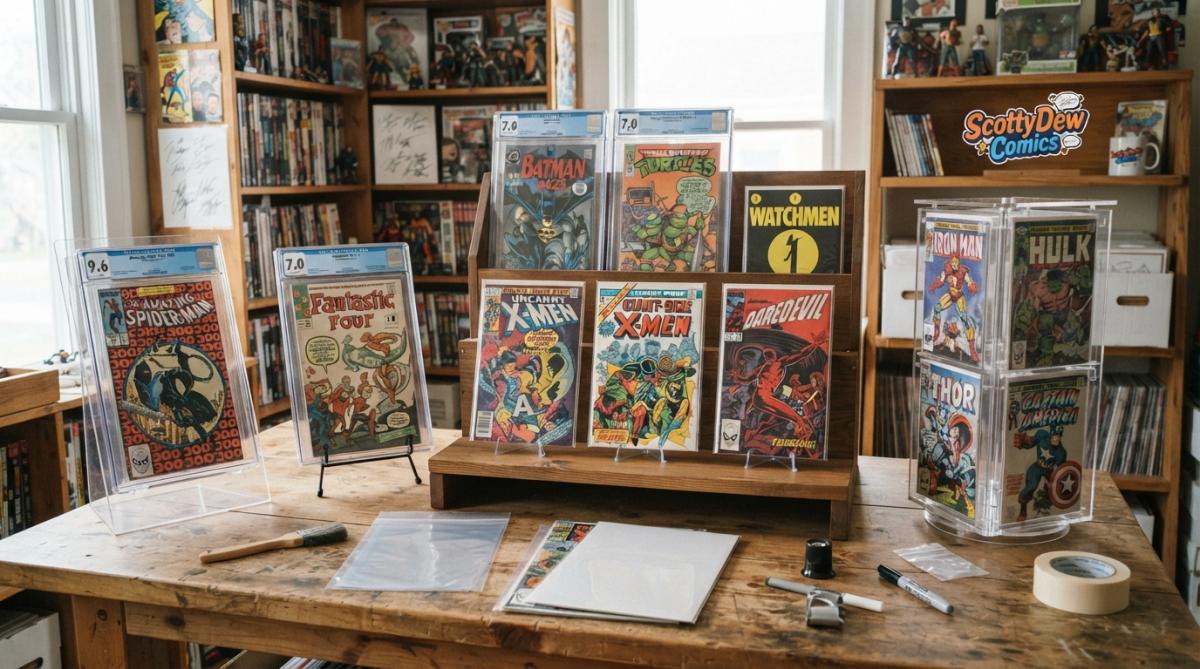
The best comic book display stands balance protection, stability, and visibility, and the right pick depends on whether you're showcasing a single raw issue or a wall of graded slabs. This guide from Scottydew Comics breaks down seven real options, from budget acrylic risers to museum-grade UV-protected cases, so you can match a stand to your collection instead of guessing.
Comic book display stands are physical supports or mounts that hold comics upright or flat for viewing while limiting handling and exposure. Serious collectors treat them as archival equipment, not decoration, because a stand that lets a slab slide or a raw book fade can quietly damage a key issue over time.
Below, we'll show you exactly how each stand performs and where it falls short. The picks here cover slabs, raw issues, bulk inventory, and convention tables.
| Stand | Starting Price | Best For | Material | Slab Compatible |
|---|---|---|---|---|
| Scottydew Comics Wham! Stand | Varies (see site) | Slabs and records | Acrylic | Yes |
| BCW Comic Book Display Case | $12.74/unit at 10 | Bulk buyers | Clear acrylic | Yes |
| Vaulted Collection Display Plus | Contact for pricing | UV protection | UV-resistant | Yes (CGC/CBCS) |
| Clear Solutions Plywood | Contact for pricing | Convention vendors | Plywood | Limited |
| IKEA Mosslanda Ledge | $9.99 | Budget wall display | Wood/composite | No |
| Generic Acrylic Stand | $5.00 | Single issues | Acrylic | Yes |
| Etsy Laser-Cut Wall Mount | $15.00 | Custom look | Acrylic | Yes |
Scottydew Comics Wham! Stand: Best for Slabs and Records
Our top pick is the Wham! Stand from Scottydew Comics because it handles the two things collectors actually display: graded slabs and vinyl records. This makes it a versatile option for displaying your collection.
The design leans into a bold, display-first aesthetic that suits a shelf, a desk, or a dedicated comic collection corner. It holds slabbed books upright, and the same form factor works for a favorite record album.
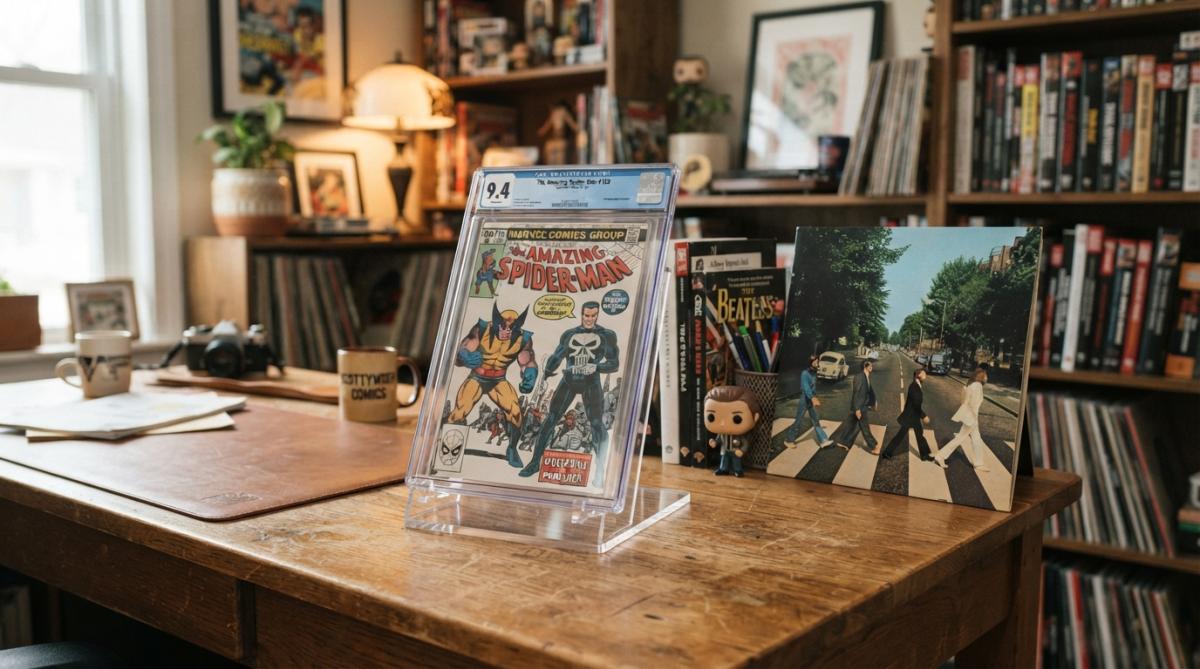
Where it fits best: collectors who want one stand that works across formats and who value a piece that looks intentional rather than improvised. If you're already part of the Scottydew Comics community, the Wham! Stand pairs naturally with the slabs and bundles that move through their live auctions.
BCW Comic Book Display Case: Best for Bulk Buyers
Bulk buyers should look at the BCW Comic Book Display Case. That volume discount is the whole point: single-unit pricing runs higher, but the per-book cost falls fast once you're outfitting a shelf.
The case is built from clear acrylic for high visibility and fits standard comic book dimensions. It works with both raw issues and slabbed books, so you don't need two product lines to cover your collection.
The tradeoff is straightforward. The individual price point sits above basic plastic stands, and you're paying for material quality and consistency across a set. For a collector displaying a full run, that consistency matters.
Vaulted Collection Comic Display Plus: Best UV Protection
Collectors showcasing high-value slabs should prioritize the Vaulted Collection Comic Display Plus, which offers strong UV protection and environmental safety. UV light fades inks and yellows paper over time, and it's the slowest, most invisible damage a display can cause.
The Display Plus uses UV-resistant materials and is built specifically for CGC and CBCS slab dimensions. A secure magnetic closure keeps the slab seated, and the museum-quality finish suits a home gallery rather than a storage bin.
What UV actually does to a comic
UV radiation breaks the chemical bonds in paper lignin and in the organic pigments used in comic inks. The visible result is the familiar progression: reds and yellows fade first, whites shift toward cream and then tan, and the paper itself becomes brittle. Heat accelerates the reaction, and humidity adds mold and foxing on top of it. That combination, light, heat, moisture, is why a slab on a sunny windowsill can look noticeably different in a few years while an identical copy in a dark box looks unchanged.
UV-blocking vs. UV-filtering: the distinction most guides skip
A material that "blocks" UV stops essentially all of it. A material that "filters" UV reduces it by some percentage, and that percentage is rarely printed on the box. Most clear acrylic sold for display passes a meaningful share of UV-A, which is the band that does the slow fading work. So a stand marketed as "UV protected" without a stated transmission figure is a marketing claim, not a measured one. When a manufacturer does publish a number, look for UV transmission at or below roughly 1% across the 300-400 nm range, that is the level archival glazing is held to.
The three environmental levers you actually control
- Direct sun. The single biggest variable. Even a UV-resistant case benefits from indirect placement; a slab that never sees direct sun ages dramatically slower than one that does.
- Heat. Attics, garages, and cars swing in temperature and bake the inks. A climate-controlled interior wall beats a dramatic display spot every time.
- Humidity. Basements and bathrooms push moisture into paper. A stable indoor range is the goal; a sealed case with a desiccant pack can help in a damp room.
Matching the case to the slab
The Display Plus is sized for CGC and CBCS holders, which is the right call because a case that fits a slab loosely lets it slide and a case that fits too tightly stresses the holder's seams. If your collection is mostly bagged and boarded rather than graded, this is the wrong tool, raw books need a different support geometry, and forcing a raw issue into a slab-sized case leaves it unsupported at the spine.
Two honest limitations. It's a premium tier product, and it's not intended for raw, unslabbed comics. If you're protecting investment-grade slabs, it's the right one.
Library of Congress preservation guidance on light exposure for paper collections
Clear Solutions Plywood Displays: Best for Convention Vendors
Convention vendors need a display that collapses flat and survives repeated setup, and Clear Solutions Plywood Comic Displays are built for exactly that. The modular plywood design assembles into custom configurations and breaks down for transport.
For a retail rack setup at a show, portability beats polish. Plywood is lighter than comparable acrylic and durable enough to handle a season of conventions. The collapsible design means it stores flat between events instead of eating garage space.
The drawbacks are real: it requires assembly, and it won't match the aesthetic of a clear acrylic display case. Vendors who care about a premium table look may want acrylic for hero books and plywood for the bulk inventory behind them.
IKEA Mosslanda Picture Ledge: Best Budget Wall Display
The IKEA Mosslanda Picture Ledge is a way to build a gallery-style wall display. It's a picture ledge, not a comic-specific product, but collectors repurpose it constantly because it works.
An integrated groove stops books from slipping forward, and the minimalist profile keeps the focus on the covers. It's available in multiple lengths, so you can run a short row or a long wall.
The catch: it requires wall mounting and drilling, and because it's not designed for comics, you're responsible for spacing and support. For a wall-mounted display of raw issues in protective sleeves, it's hard to beat on price.
How to mount a ledge without wrecking your wall or your books
This is the part most display guides skip, and it's where collectors actually get stuck. A few rules of thumb carry most of the weight:
- Find the studs first. A stud finder or a magnet that locates drywall screws will do it. Studs are typically spaced 16 inches on center in residential walls, though older construction can run 24 inches. Mark both edges of each stud with painter's tape before you drill.
- Match the anchor to the load. Into a stud, a standard wood screw is the strongest option. Into drywall only, use a hollow-wall anchor rated for the load, toggle bolts and heavy-duty self-drilling anchors hold far more than the small plastic sleeves that come in a picture-hanging kit.
- Distribute the weight. A ledge concentrates load at its mounting points, so a long ledge with a full row of slabs puts the most stress at the ends and the middle. More mounting points spread across the length is safer than two points at the extremes.
- Level before you commit. Mark the screw holes, drill pilot holes, and check level with the ledge held in place before driving the final screws. A ledge that's off by a quarter inch is visible across a long row.
- Leave a gap behind the books. Pushing covers flat against the wall traps moisture and scuffs the back of the bag. A small standoff keeps air moving and protects the cover.
Weight capacity: what a ledge will actually hold
Manufacturers rarely publish a comic-specific capacity, so the honest answer is that it depends on your anchors and your wall. As a working estimate, a raw bagged-and-boarded modern issue is light, a few ounces, while a graded slab in a hard holder is substantially heavier and concentrates that weight in a rigid block. A row of raw issues is a modest load; a row of slabs is a real one. If you're loading slabs, anchor into studs, keep the row short, and consider two ledges stacked with a gap rather than one heavily loaded shelf.
Spacing and layout
For a gallery wall, leave enough vertical clearance that the top edge of the tallest book doesn't touch the ledge above it, and enough horizontal room that covers don't overlap. A consistent gap between books reads as intentional; a tight pack reads as storage. If you're mixing raw issues and slabs, group them, the depth difference is obvious and looks better separated.
Generic Acrylic Comic Book Stand: Best for Single Issues
For a single issue on a desk, the generic acrylic stand is a simple answer. It measures 3"D x 1.75"W x 3.5"H, holds both graded and raw comics upright, and takes up almost no space.
The clear, unobtrusive design disappears behind the book, which is what you want when the cover is the point. The base is stable enough for a standard slab, and the universal fit covers standard comic sizes.
Two caveats. It can get unstable with very thick slabs, and the construction is basic plastic. This is a display stand for one or two books, not a collection. Treat it as an entry point, not a system.
Etsy Premium Laser-Cut Acrylic Wall Mount: Best Custom Look
Custom display seekers should look at the Etsy premium laser-cut acrylic wall mount. Laser-cut edges give it a cleaner finish than 3D-printed alternatives, and the solid acrylic reads as museum-quality rather than hobby-grade.
Wall-mounting hardware is included, which removes the guesswork that trips up first-time installers. The clarity is noticeably better than printed plastic, so a graded slab stays the visual focus.
Expect two tradeoffs. Shipping times vary by seller, and the cost runs above mass-produced stands. For a collector who wants a specific look and is willing to wait for it, the finish justifies the premium.
Frequently Asked Questions
Should comics be stored flat or upright?
For long-term storage, keep comics upright in a cool, dry place. Storing them flat can cause pressure damage to the spine and pages, especially if stacked high. If you display comics on stands, ensure the stand supports the book evenly and doesn't warp the cover. For raw issues, use a rigid toploader or archival bag and board before placing them upright on a shelf or in a comic book storage box.
What are the best display stands for CGC-graded comics?
Graded slabs are thicker and heavier than raw comics, so look for stands with a wide base and deep groove. The Vaulted Collection Comic Display Plus and Scottydew Comics Wham! Stand are designed for slab dimensions. If you want wall-mounted options, Etsy's laser-cut acrylic mounts offer solid support and UV protection when paired with the right materials.
How can I display my comic books without causing sun damage?
Direct sunlight fades ink and yellows paper. Use UV-protected comic book frames or display cases made with UV-resistant acrylic or glass. Place your display away from windows, and consider rotating comics every few months. The Vaulted Collection Comic Display Plus uses UV-resistant materials, and many Etsy wall mounts offer similar protection. Even with UV protection, keep displays out of direct sun.
What is the difference between a comic book stand and a display case?
A stand holds a comic upright for viewing, often with a small footprint. A display case fully encloses the comic, protecting it from dust, moisture, and UV light. Stands are best for frequently rotated or raw issues, while cases suit high-value slabs. The BCW Comic Book Display Case is a professional-grade example of a case, while the Generic Acrylic Comic Book Stand is a simple stand for single issues.
Are acrylic stands safe for long-term comic book storage?
Acrylic itself is safe, but the plasticizers in some soft plastics can off-gas and damage paper over time. Look for stands made from clear, rigid acrylic or archival-quality materials. Avoid PVC. For long-term storage, use Mylar bags and acid-free boards inside a comic book storage box. Display stands are best for rotating your collection, not for permanent storage of rare issues.
Building a display that protects your collection while showing it off comes down to matching the stand to the format: UV-resistant cases for high-value slabs, modular plywood for conventions, and budget ledges for wall galleries. Scottydew Comics can help you get there, with curated bundles, exclusive drops, and the Wham! Stand designed to showcase slabs and records with flair. Join our community and elevate your collecting journey.