 how-to
How to Find Local Comic Book Clubs Near You
Quick Summary
To find local comic book clubs, check comic shops, libraries, and bookstores first, since their staff often know which groups meet nearby. Then search Facebook, Meetup, and Reddit for active groups, and confirm each one has met recently before you commit.
- Set a realistic travel radius, such as a 20-minute drive each way, before searching.
- Use Meetup's distance filter and check the last-meeting date to spot active groups quickly.
- Confirm a group has met within the last 60 days and has a named organizer.
- Ask three offline sources, like comic shops, reference librarians, and bookstores, about nearby clubs.
- Evaluate each club on six fit factors and attend at least three meetings before deciding.
Table of Contents
- Why Local Comic Book Clubs Are Worth Finding
- Step-by-Step: How to Search for Local Comic Book Clubs
- Comic Book Clubs Near Me: Searching Events and Meetups
- Online Comic Book Communities vs. In-Person Groups
- How to Evaluate Whether a Club Is a Good Fit
- Contacting Organizers and Attending Your First Meeting
- Starting Your Own Club and Planning Meeting Ideas
- Your Next Step: Pick One Club to Visit This Month
- Frequently Asked Questions
Last Updated: November 4, 2026
Finding a local comic book club is easier than most people expect, and the search takes less time than you might think. Comic shops, libraries, bookstores, and community centers all host readers who love the same stories you do. This guide walks you through a simple, practical process for finding clubs near you, deciding which ones fit, and walking through the door at your first meeting.
Why Local Comic Book Clubs Are Worth Finding
A club gives you something a feed never will: people to talk to face to face. You get honest opinions on a new run, a second pair of eyes on a grading question, and a reason to read the books you might otherwise skip.
Local groups also teach you things. Veteran members often share what they have learned about the hobby, from back issues and rising artists to shops worth visiting. That knowledge builds up when you hear it every month.
- Real conversation, not just comment threads
- Reading goals with a deadline and a group to share them with
- Hands-on access to books you can flip through before you buy
Step-by-Step: How to Search for Local Comic Book Clubs
Most guides tell you to check a comic shop or search online, but they skip the part that actually matters: how to run a search that surfaces active groups instead of dead pages. Use this five-step process to go from zero to a shortlist of clubs you can contact this week.
Step 1: Map your realistic travel radius
Before you search, decide how far you will actually go for a monthly meeting. A 20-minute drive each way is sustainable for most people; a 45-minute drive often is not. Write down your limit in minutes, then use it to filter every result. This one decision prevents you from joining a group you will quietly stop attending after three months.
Step 2: Search by platform, not just by phrase
Different platforms surface different kinds of groups. Run the same intent through each one:
- Google or Bing: Search
"comic book club" [your city],"graphic novel book club" [your city], and"comic book meetup" [your county]. Addsite:facebook.comorsite:reddit.comto target groups hosted there. - Facebook: Use the Groups tab and search
comic book club [city]. Filter by Recent Activity so dormant groups drop out. - Meetup: Search
comics,graphic novels, andcomic books, then set the distance filter to your radius. Meetup shows the last-meeting date, which is your fastest activity check.
Step 3: Verify the group is actually active
A listing is not a club. Before you spend time contacting anyone, confirm three things:
- A meeting within the last 60 days. Check the most recent post, photo, or event date. A group that last met eight months ago is probably dormant.
- A named organizer or contact. Groups with a real person answering messages are far more likely to respond.
- A stated format. Look for whether they read one book per meeting, do show-and-tell, or just hang out. If none of that is posted, plan to ask.
Watch out: A page with a large member count but no recent posts is a common trap, member numbers reflect past interest, not current activity.
Step 4: Cross-check with offline sources
Online listings miss many groups that meet in person. Call or visit three places within your radius and ask the same question: "Do you know of a comic or graphic novel club that meets nearby?" Comic shop staff, reference librarians, and independent bookstore event coordinators are the three most reliable offline sources. Libraries in particular often host book clubs that never appear in a web search.
Step 5: Build a shortlist of three
Rank your results by activity, distance, and format fit, then keep the top three. Contact all three in the same week, organizers are more responsive when a message is fresh, and having backups means one non-response does not end your search. The next section covers how to evaluate those three before you commit.
Comic Book Clubs Near Me: Searching Events and Meetups
Online search tools make it easy to find meetups, but the right search terms matter.
Scan event listings for three details: the meeting frequency, the location, and whether the group is open to new members. Groups that meet weekly or monthly tend to build the strongest community.
Check the group's most recent posts before you commit. A page with activity in the last few weeks is a much better sign than one that has been quiet for a year.
Online Comic Book Communities vs. In-Person Groups
Online communities and in-person clubs each serve a different purpose. Many collectors use both.
| Factor | Online Communities | In-Person Groups |
|---|---|---|
| Reach | Members worldwide | Members nearby |
| Cost | Usually free | Often free, sometimes a small fee |
| Interaction | Posts and chats | Face-to-face discussion |
| Handling books | Photos only | Browse and compare in person |
| Schedule | Always open | Set meeting times |
Online groups are great for finding trades, sharing collection photos, and asking questions at any hour. In-person groups win when you want to talk through a grading decision or hold a book before you buy it.
How to Evaluate Whether a Club Is a Good Fit
A club can be active, friendly, and still wrong for you. Use a consistent set of criteria so you compare groups on the same terms instead of deciding on first impressions. Score each club from 1 to 5 on the six factors below, then total them.
The six fit factors
- Genre and format focus. Does the group read superhero titles, indie comics, manga, graphic novels, or a mix? A single-genre club is great if you love that genre and frustrating if you do not. Ask whether the reading list is set months ahead or chosen meeting by meeting.
- Meeting frequency and time. Monthly is the most common cadence. Weekly groups demand more reading; quarterly groups can feel disconnected. Check whether meetings are evenings, weekends, or weekday afternoons, a schedule you cannot keep is a dealbreaker regardless of how good the group is.
- Group size. Groups of 6 to 12 usually give everyone a chance to speak. Above roughly 20, discussion tends to split into side conversations or turn into a lecture. Ask the organizer for a typical headcount, not the online member count.
Accessibility and remote participation
Fit is not only about content. Ask whether the meeting room is wheelchair accessible, whether there is parking or transit nearby, and whether the group offers a hybrid or online option. A growing number of clubs run a video call alongside the in-person meeting, which lets you attend when travel or health makes the trip difficult. If a club has no remote option and you need one, that is useful information before you commit rather than after.
Red flags to watch for
- Every meeting doubles as a sales pitch for a specific store, grading service, or investment scheme.
- The organizer cannot tell you the next meeting date or the current reading selection.
- Newcomers are treated as an audience rather than participants.
Watch out: A club that feels cliquish on your first visit may simply be mid-conversation, judge fit after two or three meetings, not one.
Compare your shortlist
Put your top three clubs in a simple table with the six factors as rows and a 1-to-5 score in each cell. Total the columns. The highest score is your starting point, but let one hard constraint override the total: if a club fails on schedule or accessibility, drop it regardless of how well it scores elsewhere. Contact the organizer of your top choice using the template in the next section, and keep the second choice warm until you have attended at least twice.
Contacting Organizers and Attending Your First Meeting
Most organizers are glad to hear from new readers. Send a short, friendly message that says who you are, what kinds of comics you enjoy, and when you could come.
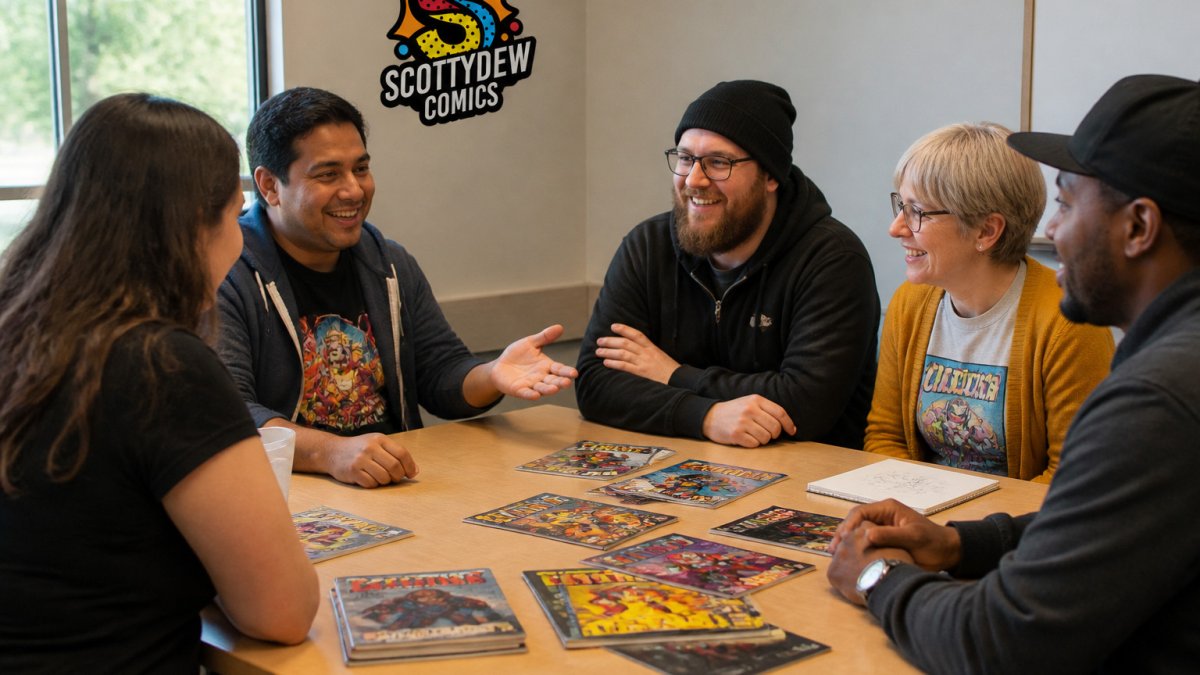
Here is a simple template you can adapt:
"Hi, I'm [your name]. I've been reading [genre or titles] for a few years and would love to join your group. Could you tell me the next meeting date and whether there's a cost to attend? Thanks!"
When you arrive, bring a book or two you want to talk about. Introduce yourself to the organizer first, then look for a friendly face to sit near. Ask one or two questions about the reading list.
Give it at least three meetings before you decide whether the group is right for you. First visits can feel awkward, and the group changes once you know people.
Starting Your Own Club and Planning Meeting Ideas
If you cannot find a group nearby, you can start one. You do not need a big budget or a formal setup to get going.
Begin with three simple steps:
- Pick a meeting spot, such as a library room, café, or your local comic shop.
- Choose a reading selection and announce it at least two weeks ahead.
- Invite people from your shop, online groups, and social media.
Keep the first few meetings simple. Good formats include:
- Monthly discussion: One book or series per meeting, with a few guiding questions
- Show-and-tell: Members bring a favorite issue and explain why it matters
- Genre night: Focus on one type, like indie comics, manga, or superhero titles
Plan each meeting with a clear start time, a short agenda, and a closing plan for next month's pick. Consistency does more to build a club than any single event.
Your Next Step: Pick One Club to Visit This Month
At Scottydew Comics, we love seeing collectors connect over the books they care about.
Frequently Asked Questions
How do I find comic book clubs near me? Start with local comic shops, libraries, and bookstores, since staff there often know which groups meet nearby.
Are comic book clubs free to join? Many are free, especially those hosted by libraries and community centers.
Can I join a comic book club online instead? Yes. Online communities let you trade, share collection photos, and discuss books at any hour.
Frequently Asked Questions
Are 40 year old comics worth anything?
Some are, but age alone does not determine value. Condition, print run, the character, and whether the issue is a first appearance or a key storyline matter far more. Many 40-year-old comics sell for modest amounts, while a small number of key issues in high grade can be worth considerably more. Local clubs are a good place to ask experienced collectors to look at your copies and explain what drives value for specific titles. For an accurate figure, check recent sold listings for the exact issue and grade rather than relying on a general rule.
Do libraries have comic book clubs?
Many public libraries host comic book clubs, graphic novel reading groups, or teen comic programs, and some run monthly discussions open to adults. Library websites and event calendars are the easiest place to check, and many branches also post flyers near their graphic novel sections. If your library does not have one, ask a librarian. Staff often know of nearby groups and may be willing to help start one, especially if you can gather a few interested patrons.
What should I ask before joining a comic book club?
Ask how often the group meets and where, whether meetings are open to new members, and whether there is a cost. Find out what kinds of comics the group focuses on, such as superhero comics, indie titles, manga, or graphic novels, and whether members choose reading selections together. It also helps to ask about the group's size and whether it has an active organizer. A short message to the organizer covering these points usually gets a clear answer quickly.
Can I join a comic book club online?
Yes. Online comic book communities on social platforms, forums, and video chat servers host discussions, reading challenges, and virtual meetups. They are useful if no local group fits your schedule or if you want to talk about a niche genre. Online groups vary widely in moderation quality, so look for clear rules, active organizers, and a track record of respectful discussion before you share personal information.