 How-to
Best Wall Mounting Hardware for Heavy Comic Book Slabs
Quick Summary
The best wall mounting hardware for heavy comic book slabs is a screw-mounted system anchored into a wood stud, since studs offer the strongest hold. Drywall needs a rated toggle or heavy-duty anchor, and adhesive squares work best as a supplement for light slabs.
- Use wood screws reaching at least 1 inch into a stud for a heavy or valuable slab.
- Weigh each slab on a kitchen scale instead of guessing its weight.
- Match the fastener's rating to your wall type, since drywall ratings are much lower.
- Never hang a slab over a bed, doorway, or seating area.
Table of Contents
- Why Hardware Choice Matters for Graded Comic Slabs
- Types of Wall Mounts for Graded Comic Slabs
- Comparing Mounting Approaches Side by Side
- Wall Anchors for Heavy Displays: Drywall Versus Studs
- How to Hang Graded Comics Safely, Step by Step
- Load Ratings, Safety Margins, and Slab Fit
- Storing Slabbed Comics When They Are Off the Wall and Choosing Your Next Mount
- Frequently Asked Questions
Why Hardware Choice Matters for Graded Comic Slabs
Graded comic slabs are heavy, rigid, and often valuable. The wrong hardware can drop a slab, scratch its case, or leave a damaged wall behind. Choosing the right wall mounting hardware protects both your investment and your drywall.
Most collectors focus on how a display looks and overlook how it holds weight. A slab sealed in a hard plastic case can weigh more than a loose book, and it sits away from the wall on a single point of support. That use puts stress on every fastener.
Comic Book Grading Standards overview explains how slabs are encapsulated, which helps explain why their weight and shape differ from raw comics.
Types of Wall Mounts for Graded Comic Slabs
Wall mounts for graded comics fall into a few broad groups. Each group uses a different attachment method, and that method decides how much weight the display can safely hold. Start by identifying how the mount attaches before you compare looks.
Screw-mounted systems use one or more fasteners driven into the wall. Adhesive systems rely on removable tape or squares. Shelf-style holders may not need a permanent fastener at all, but they take up more space.

Screw-Mounted and Single-Screw Mounts
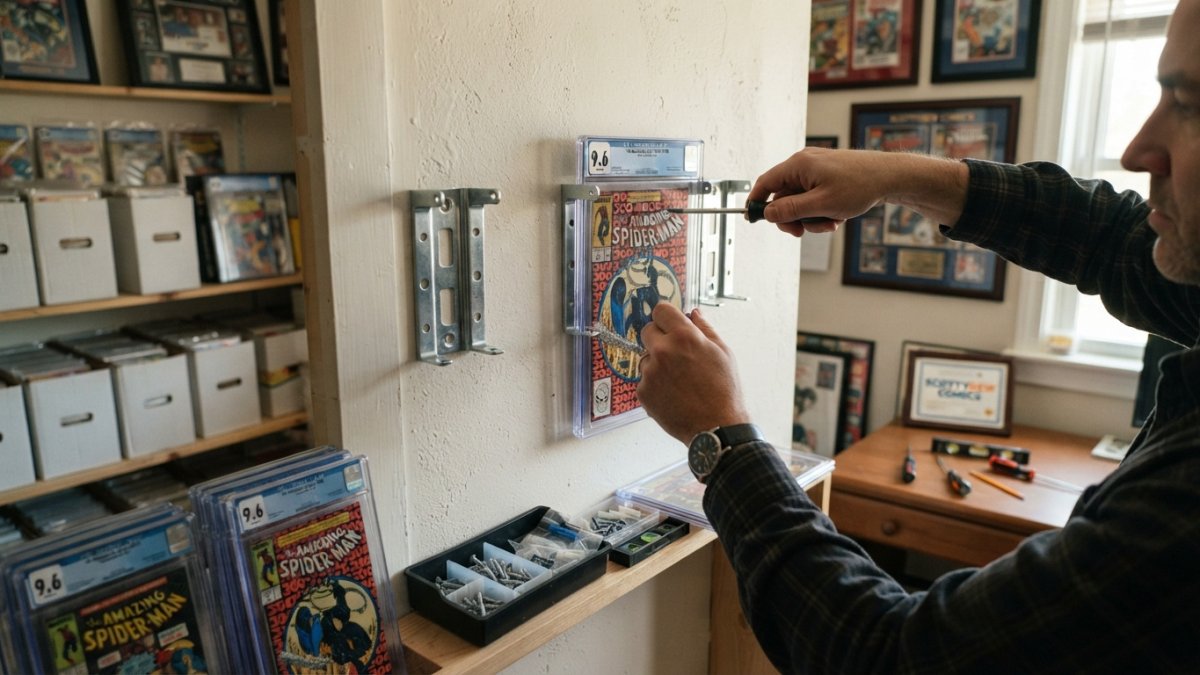
Screw-mounted displays are the most common choice for graded slabs, and the right wall mounting hardware for them is a matter of matching fastener to wall. A single-screw mount is easy to level and easy to remove, but it concentrates all the load on one point. Make sure the screw sits in a solid anchor.
Some multi-slab wall holders spread weight across several fasteners, which suits collectors who want to show a group together. Check the listed capacity and the included hardware before you buy.
Adhesive Mounting Squares and Removable Tape
Adhesive squares offer the cleanest install, with no holes in the wall. Many collectors use them for individual slabs. The trade-off is that adhesive is only as strong as the surface it bonds to and the weight it carries.
Adhesive can fail over time, especially in humid rooms or in direct sun, so check the mount periodically.
Comparing Mounting Approaches Side by Side
Each mounting approach trades off strength, convenience, and wall damage. Use this table to compare the main options before you commit.
| Approach | Typical Load | Wall Damage | Best For |
|---|---|---|---|
| Single-screw mount | Light to moderate slab | Small hole | One slab, easy leveling |
| Multi-slab holder | Several slabs | Several holes | Group displays |
| Adhesive squares | Light slab | None to minimal | Renters, no-hole installs |
| Shelf stand | Varies by shelf | None | Limited wall space |
A screw mount offers the most security for its weight, while adhesive offers the cleanest finish. Pick the approach that matches both your wall and your slab's weight.
Wall Anchors for Heavy Displays: Drywall Versus Studs
The wall behind the display decides which fastener you can trust. The same mount that is secure in a stud can pull out of bare drywall under a heavy slab. Match the fastener to the substrate before you drill anything.
Locating studs
Studs are the wood or metal framing members behind the wall. Use an electronic stud finder, and confirm each mark with a small finish nail or a magnet that finds the drywall screws. Mark both edges of each stud with painter's tape so you can see the centerline. If you cannot find a stud where you want the display, you have two choices: move the display to a stud, or use a rated anchor in the drywall.
Fasteners by wall type
- Wood studs: Use wood screws long enough to reach at least 1 inch into the stud. This is the strongest option and the first choice for a heavy or valuable slab.
- Drywall (hollow wall): Use a rated toggle-style anchor or a heavy-duty self-drilling anchor sized for the load. Follow the anchor's published rating for your drywall thickness.
- Plaster and lath: Treat it like drywall but expect more resistance when drilling. Use a toggle anchor that opens behind the lath, and pre-drill carefully to avoid cracking the plaster.
- Masonry (brick, block, concrete): Use masonry anchors and a masonry bit, and drill at the recommended diameter. Avoid drilling into mortar joints, which are weaker than the brick or block.
Why adhesive alone is a risk
Adhesive squares and removable tape are convenient, but their hold depends on the surface, the temperature, and the weight. For a valuable slab, do not rely on adhesive alone as the only support. Adhesive can creep or release in humid rooms or in direct sun. If you want a no-hole look, use adhesive as a supplement to a mechanical fastener, not as a replacement for one.
Installation steps that prevent failures
- Confirm the wall type and choose the matching fastener.
- Mark the mount holes, then check that at least one hole lands on a stud centerline when possible.
- Pre-drill pilot holes to the fastener's recommended diameter.
- Set anchors fully, then drive screws until snug, do not overtighten, which can strip drywall or crack plaster.
- Hang the mount, then test the hold with a gentle downward pull before adding the slab.
Watch out: never hang a slab over a bed, a doorway, or a seat. A failed fastener can drop the slab and injure someone.
For background on securing items to walls to reduce tip and fall risks, the Consumer Product Safety Commission home safety guidance covers anchoring and wall-mounting safety.
How to Hang Graded Comics Safely, Step by Step
Follow these steps in order. Rushing the layout is the most common cause of a crooked or unstable display.
- Measure the slab. Note its height, width, and depth, including the case.
- Choose the mount. Match the mount to the slab's size and weight.
- Find a stud or anchor point. Locate studs and mark them.
- Mark the height. Hold the mount in place and mark the screw holes with a pencil.
- Pre-drill and install anchors. Drill pilot holes and set any anchors.
- Attach the mount. Drive screws until snug, but do not overtighten them.
- Level and test. Place the slab, check it with a level, and gently test the hold.
Watch out: never hang a slab over a bed, a doorway, or a place where people sit. A fall can injure someone and damage the case.
Load Ratings, Safety Margins, and Slab Fit
Some product listings describe a mount as "heavy duty" or "strong" without publishing a tested capacity. That leaves you to estimate. The practical approach is to build your own load budget: weigh the slab, add a safety factor, and compare that number to the fastener and mount ratings you can actually verify.
Estimating slab weight
A graded comic slab is a hard plastic case with an inner well, a label, and the book itself. The case dominates the weight. Do not trust a guess for a valuable book, put the slab on a kitchen scale and record the number. If you are mounting several, weigh one and multiply, then add a little for variation between cases.
Applying a safety factor
Treat every published capacity as a ceiling, not a target. Keep the actual load well below the fastener's rated capacity so that normal vibration and humidity do not push the hardware toward failure. That margin costs little and covers the cases where a mount loosens over time.
What the numbers actually mean
Fastener ratings are usually given per fastener in a specific substrate, for example, a toggle anchor rated for a given load in 1/2-inch drywall, or a wood screw rated in a stud. Those ratings do not transfer. A screw that holds 50 pounds in a stud may hold a fraction of that in drywall alone. When you compare mounts, compare the rating that matches your wall, not the headline number on the box.
Slab fit across case types
Fit matters as much as load. Graded cases vary in outside dimensions, and a mount designed for one case style can pinch, rattle, or fail to grip another. Measure the slab's height, width, and depth with the case on, then compare those numbers to the mount's stated opening or clip range. A slab that rocks or tilts in the holder puts uneven stress on the fastener and can scratch the case edge.
Red flags in listings
Be cautious with any listing that gives no weight rating, no installation method, or no size range. Ask the seller for those details before you buy. A mount that cannot tell you what it holds is a mount you cannot safely load.
Storing Slabbed Comics When They Are Off the Wall and Choosing Your Next Mount
Take slabs down when you rotate displays or move. Store them upright in a padded box, away from direct sunlight and humidity. This protects the case seal and the comic inside.
When you choose your next mount, weigh how often you plan to change the display. Frequent changes favor removable adhesive or a shelf stand. A permanent display favors a screw-mounted system anchored into a stud.
Browse Scottydew Comics for display solutions and collectible slabs. For dedicated display options, see the Wham! Stand, a stylish stand for showing comics, slabs, and records.
Frequently Asked Questions
What is the best way to hang comic books on my wall?
For a graded slab, a purpose-made wall mount that fits your slab's dimensions is the safest choice. Check that the mounting hardware suits your wall type. Mount into a stud where you can, since a stud carries far more load than drywall alone. Keep the slab out of direct sunlight, and check the mount periodically for loosening screws or sagging. Pricing and availability vary by product, so confirm current prices directly with the seller or on Scottydew Comics's website before you buy.
What wall anchors should you use for a heavy comic slab display?
If the mount cannot go into a stud, use a drywall anchor rated for more weight than the full display will carry, including the slab, case, and mount. Pick anchors rated for the load and install them into solid drywall, following the anchor manufacturer's instructions for hole size and depth. Avoid relying on adhesive alone for heavy slabs, because adhesive can fail over time under sustained weight. Test the installation by applying gentle pressure before you hang the slab. Confirm the anchor's stated weight rating with the manufacturer, since the supplied research does not verify load ratings for every mount listed.
Should comic slab mounts be attached to a wall stud?
Attaching to a wall stud is the most reliable option for heavier displays, because studs provide solid, secure support that drywall anchors cannot match. Use a stud finder to locate the stud center, then drive mounting screws into the stud at the spacing the mount requires. If your layout does not line up with a stud, combine the mount with properly rated anchors rather than hanging the slab on one unsupported point. Measure before drilling, and mark the placement with a level to keep the slab straight.
How should slabbed comics be stored when they are not on display?
Store graded slabs upright or flat in a stable, dry location away from direct sunlight, heat, and humidity swings, which can affect the case and the comic over time. Keep slabs out of attics and basements where temperature and moisture fluctuate. Use a sturdy box or shelf that fully supports the case so it cannot shift or slide. Handle slabs by their edges and avoid stacking them under heavy items, which can crack or stress the case.