
 ultimate-guide
Comic Collecting for Casual Readers: A Beginner's Guide
Table of Contents
- Reading vs Collecting Comics: What's Right for You
- Choosing Your Niche: Finding Comics That Matter to You
- Where to Buy Comics: Building Your Reading Habit
- How to Organize a Comic Book Collection on Any Budget
- Best Comic Storage Supplies for Beginners
- Understanding Comic Book Grading and Condition
- Comic Collecting for Casual Readers: The Dos and Don'ts
- Joining the Community: Events, Conventions, and Live Auctions
- Frequently Asked Questions
Last Updated: September 22, 2026
Reading vs Collecting Comics: What's Right for You
The line between reading comics and collecting them isn't always clear. Some people grab a graphic novel, read it once, and move on. Others obsess over condition, hunt for key issues, and debate the merits of different publishers. The truth is both approaches are valid, and you don't have to choose one forever.
Reading is about the story. You want to follow a narrative, experience the art, and enjoy the medium without worrying about resale value or whether a spine is slightly creased. Collecting, on the other hand, introduces preservation concerns. You're thinking about long-term storage, condition grades, and whether you're building something with financial or sentimental worth.
For casual readers getting into comic collecting, the sweet spot is often a hybrid approach. You read what you love while being intentional about keeping your favorites in good shape. This means understanding the basics of protection without obsessing over grading standards designed for investment-grade slabs.
Choosing Your Niche: Finding Comics That Matter to You
Jumping into comic collecting for casual readers works best when you pick a niche that actually interests you. A niche isn't about exclusivity, it's about focus. Instead of trying to own every comic ever published, you're narrowing down to what resonates with you personally.
Your niche could be a specific character (Batman, Spider-Man, X-Men), a publisher (Marvel, DC, Image), a genre (horror, sci-fi, romance), or even a creative team whose work you follow obsessively. The narrower your focus, the easier it becomes to understand the landscape and make informed decisions about what's worth your money and shelf space.
Start by asking yourself what you actually read. Did you watch a Marvel movie and want the source material? Are you nostalgic for comics from your childhood? Do you follow a particular artist's linework across different titles? Your answer points toward your niche.
Single Issues vs Trade Paperbacks vs Graphic Novels
Three main formats dominate comic collecting for casual readers: single issues, trade paperbacks, and graphic novels. Each serves a different purpose.
Single issues are the individual comic books you find in shops, typically 20-30 pages, released monthly or bi-weekly. They're affordable, collectible, and let you follow a story as it unfolds. The downside: single issues take up more space relative to their page count.
Trade paperbacks collect 4-6 single issues into one bound volume. They're cheaper per page than buying singles individually, easier to store, and perfect for reading a complete story arc in one sitting. Many casual readers prefer trades because they eliminate the commitment of monthly pulls and the clutter of managing dozens of thin issues.
Graphic novels are self-contained stories published as complete books from the start. They're often more literary, beautifully produced, and designed for readers who want a finished product rather than an ongoing series. Graphic novels appeal to people who see comics as books first and collectibles second.
For comic collecting for casual readers, trades and graphic novels often make more sense financially and practically. You get more story per dollar, better storage efficiency, and less pressure to hunt down specific back issues to complete a run.
Exploring Story Arcs and Key Issues
A story arc is a multi-issue narrative that builds to a conclusion. Following a story arc teaches you how comics work as a serialized medium. Unlike graphic novels, where everything wraps up in one book, story arcs reward patience and monthly engagement.
Key issues are single issues that introduce important characters, landmark moments, or first appearances. The term "key issues" usually applies to older comics with significant historical or cultural weight. For casual readers, understanding key issues matters less than understanding story arcs, unless you're chasing a character's origin story or a pivotal moment you genuinely care about.
Where to Buy Comics: Building Your Reading Habit
Your buying strategy shapes your entire collecting experience. You have several options, each with trade-offs.
Local comic shops offer the social experience and expert staff recommendations. You can flip through issues before buying, join a pull list for reliable monthly deliveries, and support a community hub. The downside is selection varies wildly by location.
Online retailers offer competitive pricing, broader selection, and convenience. You can browse thousands of titles without leaving home. However, you miss the tactile experience of handling comics before purchase and the community aspect.
Subscription services like Marvel Unlimited offer digital access to thousands of comics for a monthly fee. They're great for exploring without commitment, but digital reading doesn't satisfy the collecting impulse for most people.
Live auctions and community events like those hosted by Scottydew Comics on the Whatnot platform combine the excitement of discovery with competitive pricing. You're bidding against other collectors in real time, which creates urgency but also teaches you market value. This format works well for casual readers who want rare finds without the pressure of investment-grade collecting.
For comic collecting for casual readers, a hybrid approach usually wins: use a local shop for community connection, supplement with online purchases for specific issues, and occasionally bid on live auctions for special finds.
How to Organize a Comic Book Collection on Any Budget
Organization doesn't require expensive infrastructure. It requires a system that works for your space and your collection size.
Start by sorting your comics into categories that make sense to you. Many collectors organize by publisher (Marvel, DC, Image, independent), then by series, then by issue number. Others organize by character or genre. The system matters less than consistency, pick one and stick with it.
Your collection will likely outgrow a shelf quickly. That's when you need storage solutions.
Long Boxes, Short Boxes, and Display Options
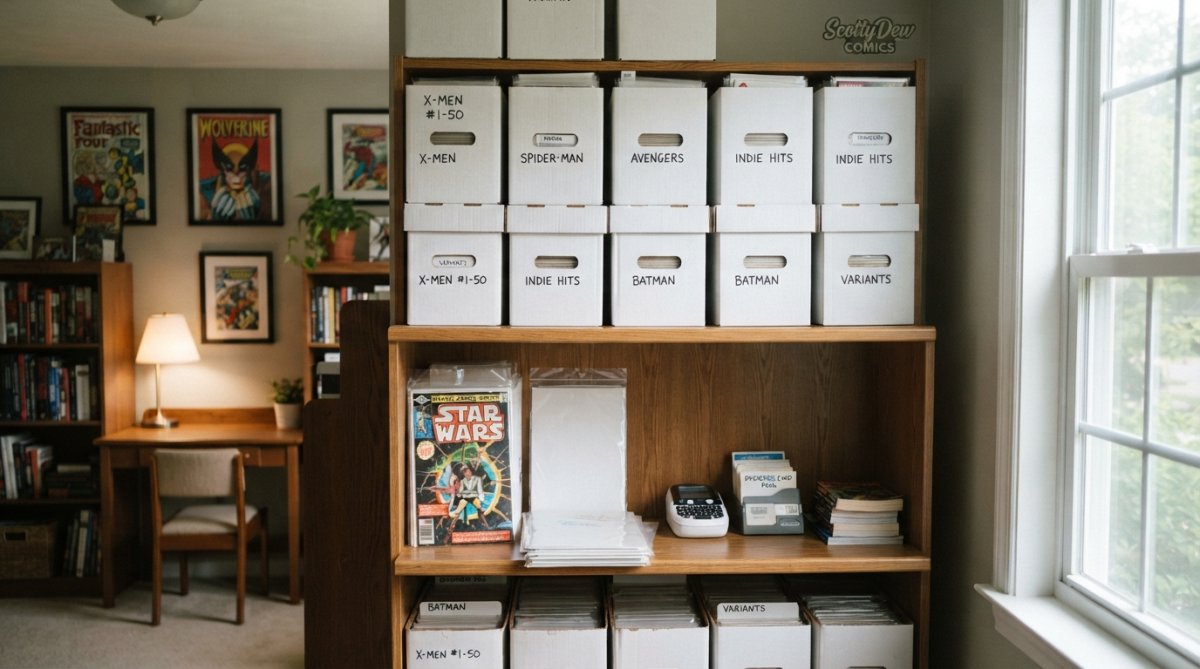
Long boxes hold approximately 150-200 single issues standing upright. They're the industry standard for serious collectors because they maximize space efficiency. Short boxes hold roughly 75-100 comics and work better for smaller collections or dedicated display areas.
For casual readers, short boxes often make more sense. They're easier to move, take up less floor space, and prevent the "out of sight, out of mind" problem that happens when comics disappear into long boxes.
Display options range from simple shelving to dedicated display stands. The Wham! Stand from Scottydew Comics offers a stylish, functional solution for showing off your favorite slabs and collectibles without requiring wall space or complex installation. For casual readers with limited space, vertical shelving with adjustable brackets works well, you can display your favorites while keeping bulk storage in boxes underneath.
The Basics of Bag and Board Protection
Bag and board protection is the minimum standard for preserving comics. A bag is an archival-quality plastic sleeve that prevents dust and physical contact. A board is acid-free backing material that keeps the comic flat and protected.
Bagging and boarding takes minutes per comic and costs pennies. It's the single best investment in preservation for casual readers. You're not aiming for museum-quality preservation, you're just preventing unnecessary damage.
Standard bags and boards work fine for casual collecting.
Best Comic Storage Supplies for Beginners
Storage supplies for beginners should be simple, affordable, and effective. You need bags, boards, boxes, and that's honestly it.
Understanding Comic Book Grading and Condition
Comic book grading is a standardized system that rates condition on a scale from 0.5 (poor) to 10 (gem mint). Most casual readers don't need to understand the full grading scale, but knowing the basics helps you evaluate what you're buying.
Comic Collecting for Casual Readers: The Dos and Don'ts
Do buy what you actually want to read. Your collection should reflect your interests, not what you think you should own.
Joining the Community: Events, Conventions, and Live Auctions
Comic collecting for casual readers is better with community. You discover new titles, learn from experienced collectors, and share enthusiasm with people who get it.
Frequently Asked Questions
What is the difference between reading comics and collecting them?
Reading comics focuses on enjoying the story and art without concern for condition or resale value. Collecting involves preserving comics in good condition, often storing them long-term, and building a curated library. Casual collectors can do both, reading your favorite issues while keeping others in pristine condition. The mindset differs: readers prioritize the experience, while collectors balance enjoyment with preservation and organization.
Do I need to buy graded comics to be a casual collector?
No. Graded comics are slabs certified by professional grading services and cost more. Casual collectors typically buy ungraded single issues or trade paperbacks from comic shops or subscription services. Grading matters most to serious investors. Start with affordable, ungraded comics you enjoy, store them properly in bag and board, and only explore grading later if you want to preserve high-value key issues.
What are the best tips for starting a comic collection on a budget?
Focus on trade paperbacks and graphic novels instead of expensive single issues. Buy back issues instead of new releases. Join community events and live auctions where you can find deals on curated bundles. Start with one publisher or character you love, then expand. Use affordable storage supplies like long boxes and basic bag and board protection rather than premium options.
How should casual readers store their comic books?
Use long boxes or short boxes for bulk storage, keeping comics upright or flat depending on your space. Protect individual issues with bag and board to prevent damage. Store in a cool, dry place away from direct sunlight and moisture. For comics you display frequently, consider a stylish display stand that keeps them accessible and visible. Organize by publisher, character, or story arc so you can find what you want. Proper storage preserves your collection's condition and value over time.