 ultimate-guide
Comic Book Investment Strategy Guide 2026
Table of Contents
- How Comic Book Investing Works
- Getting Started with Comic Book Investment Strategy
- How to Grade Comic Books Before You Invest
- Best Comic Books to Invest In Right Now
- Using a Comic Book Price Guide for Valuation
- Understanding Comic Book Investment Risks
- Building Your Investment Portfolio and Exit Strategy
- Frequently Asked Questions
Last Updated: October 9, 2026
How Comic Book Investing Works
Comic book investing means buying comics expecting their value to appreciate, so collectors can realize capital gains when they sell. A comic book investment strategy focuses on key issues, rare printings, and graded comics that command premium prices in the secondary market.
The fundamentals are simple: buy low, hold strategically, sell when conditions favor appreciation. A first appearance, a historically significant issue, or a comic in exceptional condition can appreciate substantially, while common books in poor condition often stagnate or decline.
The market rewards specificity: a random 1990s comic might sit for years, while that era's variant cover of a character's debut moves.
Getting Started with Comic Book Investment Strategy
Starting a comic book investment strategy requires three steps: establish your budget, research the market, and define your focus.
Determine how much capital you can allocate without disrupting your financial stability. Comic book investment isn't a get-rich-quick scheme; serious investors commit to multi-year holding periods, buying individual key issues or a diversified portfolio across eras and characters.
Next, learn the comic book ages. The Golden Age (1938-1956) produced the rarest, most valuable books, but entry prices are steep. Silver Age (1956-1970) comics remain highly collectible at more accessible prices. Bronze Age (1970-1985) and Modern Age (1985-present) offer speculation opportunities with higher volatility and risk.
Finally, choose your focus: specific characters, publishers, or eras? Slabbed or raw books? Key issues or undervalued gems? Your comic book investment strategy should align with your knowledge, budget, and patience.
How to Grade Comic Books Before You Invest
Grading is the standardized assessment of a comic book's condition on a numerical scale from 0.5 (Poor) to 10.0 (Gem Mint). Professional grading determines whether a book qualifies as investment-grade and directly impacts its market value.
Before purchasing any comic for investment, understand the grading scale.
Key grading factors include centering, corner wear, spine stress, and page quality.
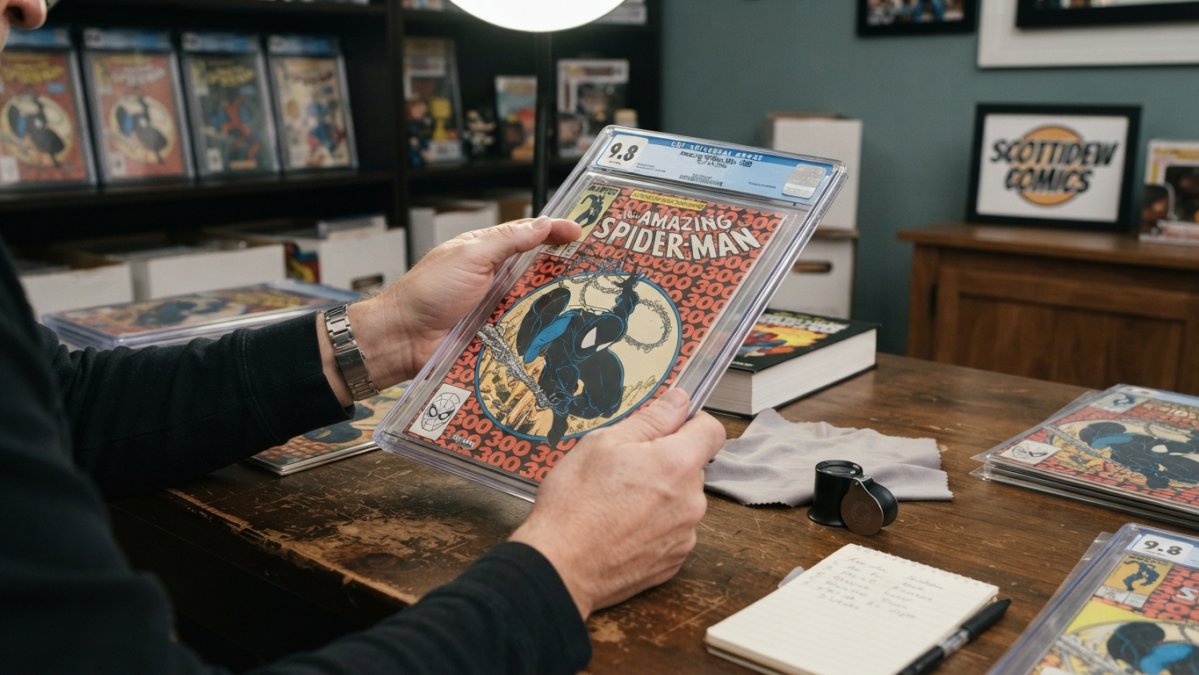
Most serious investors buy professionally graded and slabbed comics from established grading companies. Slabbed comics come encased in protective plastic with a grade label, authentication, and a unique certification number, creating market confidence and enabling price comparisons.
If you're buying raw (ungraded) comics for investment, learn to spot condition issues yourself: creasing, water damage, foxing (age spots), and spine stress.
Best Comic Books to Invest In Right Now
The strongest investment opportunities combine scarcity, cultural relevance, and collector demand. Focus on key issues: first appearances of major characters, origin stories, and historically significant issues.
Golden Age key issues remain the gold standard. Action Comics #1 (first Superman), Detective Comics #27 (first Batman), and Amazing Fantasy #15 (first Spider-Man) are the holy grails, commanding six or seven-figure prices, but lower-grade copies of other Golden Age keys remain accessible.
Silver Age comics offer the best balance of value and appreciation potential. The first appearances of the X-Men, the Hulk, and Iron Man consistently appreciate.
Bronze Age and Modern Age comics present higher risk but lower entry cost.
The most important principle: buy what has staying power. Characters with decades of cultural relevance, books with genuine historical significance, and comics in exceptional condition tend to appreciate steadily. Speculative plays on minor characters or low-grade copies are riskier.
Using a Comic Book Price Guide for Valuation
A comic book price guide is only a starting point. The real skill is running a repeatable valuation and due-diligence process before committing capital.
Here is a framework you can apply to any book, in any grade, in any era.
Step 1: Pull comparable sales, not asking prices. Look for completed sales of the same issue in the same grade within the last 90 days.
Step 3: Adjust for condition within the grade. Two books both graded 9.6 are not identical.
Step 4: Model the round-trip cost. The price you pay is not the price you'll net. Build a simple cost stack:
- Buyer's premium or sales tax at purchase (varies by state and channel)
- Grading and pressing fees if you're submitting raw books
- Insured shipping both directions
- Selling commission (auction houses commonly charge 15-20%; online marketplaces vary)
- Payment processing fees
- Capital gains tax on the eventual sale
A book that appreciates 25% over three years can net close to zero after a full round trip if you bought at retail, graded it, and sold through a traditional auction house.
Step 5: Sanity-check against the broader market. Is the book's price rising from genuine collector demand or a temporary media event? Compare its 12-month trend to similar keys from the same era.
CGC population report lookup GPAnalysis and GoCollect sold-comps databases
Beware of "guide price" anchoring. Dealers who quote a guide price and then offer a 10% discount are often still selling above true market. Always verify against recent sold comps in the same grade before accepting any quoted price.
Understanding Comic Book Investment Risks
Comic book investing carries risks that most guides gloss over. The categories below determine whether you make money, and each comes with a concrete way to manage it.
Liquidity risk. Comics are illiquid.
Condition risk. Physical assets degrade. Even slabbed books suffer from environmental exposure, and raw books degrade faster.
Market risk and speculation cycles. Comic values move with character popularity, media events, and collector sentiment.
Authentication and restoration risk. Counterfeits exist at the highest price tiers, and restoration (color touch, trimming, piece replacement) is sometimes undetectable without professional review.
Concentration risk. If 60% of your portfolio is Silver Age Marvel keys, you're not diversified, you're making a single bet on one publisher, one era, and one demand cycle. A practical long-term allocation might look like:
- 25-35% in established keys across multiple eras
- 20-30% in mid-grade Silver and Bronze Age books with proven demand
- 10-20% in modern keys and variants, sized small because of volatility
- 10-20% held in cash or equivalents so you can buy when others are forced to sell
- 5-10% in higher-risk speculative positions you can afford to lose entirely
These ranges are illustrative, not prescriptive. The point is to decide your allocation before you buy, not after.
Net return reality check. Appreciation headlines are misleading. Model the full round trip:
- Purchase price plus buyer's premium or tax
- Grading and pressing (if applicable)
- Insured shipping and storage
- Selling commission (15-20% at many auction houses)
- Payment fees
- Capital gains tax on the gain
Opportunity cost. Capital tied up in comics isn't earning returns elsewhere.
Media-driven price spikes are the most common way new investors lose money. When a character appears in a major film or series, prices for their key issues often peak within days of the announcement or release. Buying at that peak means holding through the decline. If you already own the book, a spike is a chance to sell into strength.
Investors who want to understand downside scenarios before they commit capital, not after. A disciplined framework for position sizing, storage, verification, and net-return modeling separates a portfolio from a pile of books.
Building Your Investment Portfolio and Exit Strategy
A sustainable comic book investment strategy requires thoughtful portfolio construction and a clear exit plan.
Portfolio diversification reduces risk. Avoid concentrating capital in a single character, era, or condition tier. A balanced approach might include:
- 30% Golden Age key issues (highest value, lowest liquidity)
- 40% Silver Age key issues (strong appreciation history, moderate liquidity)
- 20% Bronze Age speculative positions (higher risk, better liquidity)
- 10% Modern Age variant covers and low-print-run issues (highest volatility)
Holding periods matter. Short-term speculation (buying and selling within months) requires expert timing and exposes you to transaction costs.
Exit strategy is critical. Decide in advance when you'll sell: at a specific price target, a grade threshold, or a peak in a character's cultural relevance? Will you sell gradually (dollar-cost-out) or all at once?
Consider transaction costs. Auction houses charge 15-20% commission, online marketplaces charge fees, and shipping and insurance add costs.
Scottydew Comics' live auction platform on Whatnot provides transparent price discovery and community engagement. Selling through live auctions reaches active collectors in real time, often driving competitive bidding.
Collectors building long-term portfolios who want access to rare key issues, professional grading guidance, and a community of serious investors. Scottydew Comics combines curated inventory, live auction transparency, and community events that help you make informed decisions and find authentic investment opportunities.
Building a successful comic book investment strategy requires patience, research, and discipline. The market rewards collectors who understand scarcity, condition, and cultural relevance, and who resist chasing hype.
Frequently Asked Questions
Are comic books a good investment in 2026?
Comic books can appreciate if you focus on key issues, first appearances, and iconic characters with proven collector demand. However, success requires research, patience, and realistic expectations about liquidity and market timing. Not all comics appreciate, most depreciate. A diversified approach combining rare Golden and Silver Age issues with carefully selected Modern Age books offers better risk-adjusted returns than speculation alone.
How do you grade comic books before investing?
Grading evaluates condition on a scale from 0.5 (poor) to 10 (gem mint). Assess cover gloss, creases, tears, stains, and spine integrity. Professional grading by third-party services like CGC or CBCS provides certified grades and slabbed protection, which typically increases market value and buyer confidence. Learn the Overstreet grading standards to make informed decisions before purchasing ungraded comics.
Which comic books are worth investing in?
Key issues, first appearances, origin stories, and iconic character debuts, typically hold value better than standard issues. Action Comics #1, Amazing Fantasy #15, and Detective Comics #27 remain benchmarks. Silver Age (1956-1970) and Bronze Age (1970-1985) books with strong cultural relevance appreciate steadily. Modern variants and limited prints can spike short-term but carry higher speculation risk. Focus on scarcity, condition, and proven collector demand.
How do I research comic book prices and find fair market value?
Use comic book price guides like Overstreet, check recent comparable sales on auction platforms, and monitor market data from professional grading services. Compare graded slab prices across multiple sales to establish realistic fair market value. Account for condition grade, print run scarcity, and cultural relevance when evaluating pricing. Avoid relying on asking prices alone, actual sold prices reveal true market demand.
What are the main risks of comic book investing?
Key risks include market illiquidity (slow sales at desired prices), condition degradation over time, speculation bubbles in Modern Age variants, and tax liability on capital gains. Transaction costs from auction fees and grading reduce net returns. Market demand shifts with pop culture trends, a character's movie flop can tank values. Diversification across ages, genres, and character types helps mitigate concentration risk.
Does professional grading increase a comic's value?
Yes, professional grading and slabbed protection typically increase value by 20-50% compared to ungraded copies, depending on grade and rarity. Certified grades from CGC or CBCS provide buyer confidence, enable easier resale, and protect against condition disputes. However, grading costs ($10-$100+ per book) must be weighed against the book's value and appreciation potential. Grading makes sense for high-value key issues but may not justify costs for lower-value books.
How long should I hold a comic book investment?
Most serious investors hold key issues for 5-10+ years to capture sustained appreciation and avoid short-term market volatility. Rarity and condition typically appreciate slowly but steadily over time. Modern speculation plays often peak within 1-3 years, making them higher-risk bets. Your time horizon depends on your goals, long-term wealth building favors established key issues; shorter horizons require active market monitoring and exit discipline.
What's the difference between a key issue and a regular comic book?
Key issues feature first appearances, origin stories, or iconic moments tied to major characters or cultural events. They carry scarcity, collector demand, and proven appreciation history. Regular issues, even from the same run, typically hold little value unless they're high-grade Silver or Golden Age copies. Key issues command premium prices because demand remains consistent; regular issues depend heavily on grade and nostalgia, making them riskier investments.