 ultimate-guide
How to Find Rare Key Issue Comics in 2026
Table of Contents
- What Makes a Comic a Key Issue?
- How to Identify Key Comic Issues: First Appearances and More
- Where to Hunt for Hidden Gems
- Using Price Guides and the CGC Census Effectively
- Understanding Comic Book Grading Standards
- Raw vs Slabbed Comics: Which Should You Buy?
- The Psychology of Hype vs. Long-Term Value
- Conclusion: Build Your Collection with a Strategy
- Frequently Asked Questions
Last Updated: September 7, 2026
What Makes a Comic a Key Issue?
A key issue comic is any book that holds outsized significance to collectors due to a first appearance, a major character death, an origin story, or a landmark creative run. These are the books that anchor a collection and drive the broader market.
The most direct path starts with understanding what creates demand. A first appearance introduces a character the world will fall in love with; a death issue or origin story marks a turning point. Rarity and condition then determine how much that demand translates into market value.
Below, we'll show you exactly how to identify these books, where to hunt for them, and how to avoid the traps that catch most beginners.
How to Identify Key Comic Issues: First Appearances and More
Identifying key issue comics is a learnable skill. The process combines knowledge of character history, publication dates, and the physical traits of a specific printing. Here is the practical process for moving from casual reader to confident identifier.
First Appearances, Origin Stories, and Deaths
The most reliable way to spot a key issue is to track character milestones. A first appearance is the strongest signal, followed closely by origin stories and the death of a major character.
When a new movie or show is announced, prices often spike. The trick is learning to spot the next key issue before the hype. Follow creative teams and pay attention to which characters are being set up for bigger stories.
The Physical Identification Checklist
Before you even check a price guide, run a physical inspection to confirm you are holding the right book. A common pattern is a collector finding a familiar cover, assuming it is the key issue, and missing that it is a later printing or a variant.
Check the cover price and logo. A first printing of a Marvel comic from the 1960s will have a cover price of 12 cents. If it says 15 cents, it is a reprint. The same logic applies to DC books from the same era. This single check eliminates more false positives than any other technique.
Inspect the interior pages for printing identifiers. Look at the first few pages for the indicia, the small-print legal information. It will list the printing number and the publication date. A book marked "Second Printing" is not a key issue in the same way the first printing is.
Check for a "Marvel Value Stamp" or a DC bullet logo. These physical markers changed over time and can help you date a book within a few months. A first appearance in a later printing is worth a fraction of the original.
Use the UPC code as a date stamp. For books published after 1979, the presence of a UPC code versus a corner box graphic tells you whether you have a newsstand or direct edition. Newsstand editions were printed in smaller quantities and are often rarer, but they were also handled more roughly.
Golden Age vs. Silver Age vs. Modern Age
Understanding the age of a book helps you calibrate your expectations. Golden Age (1938-1956) books are rare and expensive. Silver Age (1956-1970) introduced many iconic characters, and Bronze Age (1970-1985) followed with darker storytelling. Modern Age (1985-present) books are far more plentiful, which means condition matters enormously.
For most collectors, the Modern Age offers the best balance of affordability and growth potential. Many modern keys are still available in high grade.
Where to Hunt for Hidden Gems
The hunt itself is where collectors earn their knowledge. Both physical shops and online marketplaces reward preparation, and each venue has its own rhythm.
Mastering the Back Issue Bin
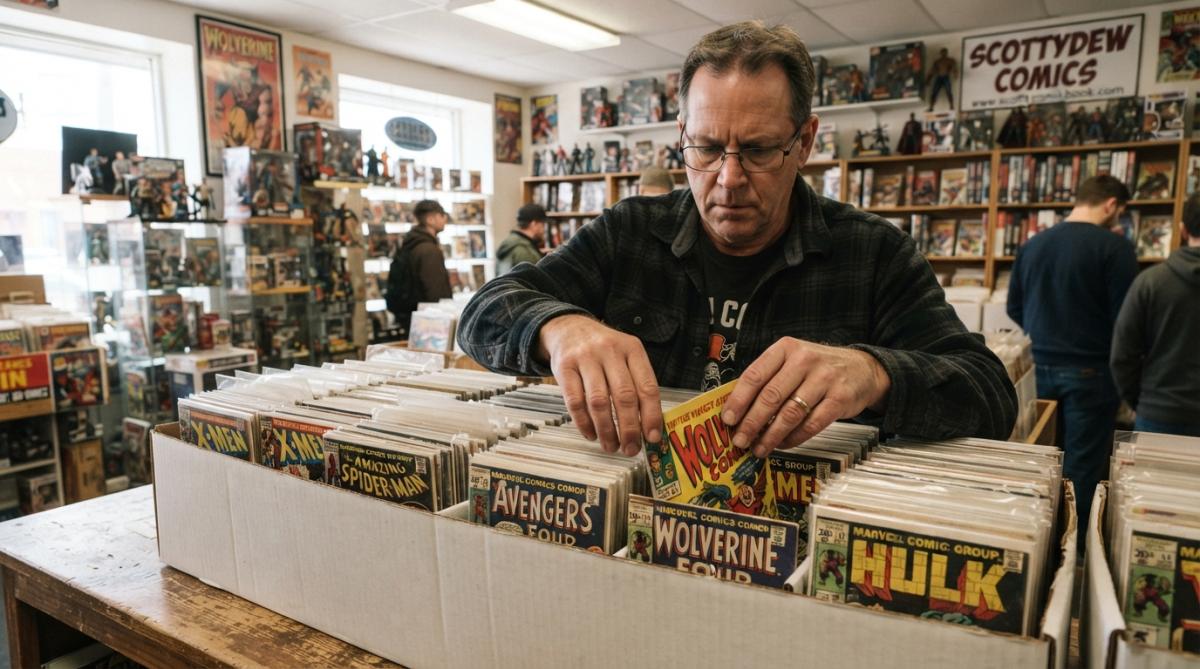
The back issue bin remains the classic proving ground for collectors. It rewards patience and a willingness to dig through hundreds of ordinary books to find one hidden gem. Start by knowing the publication dates for the keys you're chasing.
A common mistake is ignoring books that look rough at first glance. A book with a crease or a slightly worn cover can still be a valuable key if the interior is intact. Learn to separate cosmetic wear from structural damage. Check the top and bottom of every stack; that is where oddball books tend to settle.
Navigating Online Marketplaces Safely
Online marketplaces have expanded the hunt far beyond the local shop, but they demand a different set of skills. Always request additional photos from sellers, especially close-ups of the spine, corners, and cover gloss. If a seller cannot provide clear images, move on.
Check seller ratings and sales history before bidding. Be especially careful with books listed as "high grade" without a third-party certification. Live auction platforms like the ones Scottydew Comics runs on Whatnot offer a middle ground: you can see the book on video before you commit, and sellers are accountable to their reputation.
Using Price Guides and the CGC Census Effectively
Price guides give you a starting point, but the Overstreet Comic Book Price Guide is best understood as a historical record rather than a live market tracker. For current market value, you need to cross-reference guide prices with recent sales data from auction sites and the CGC Census, which tracks every graded comic in existence.
The CGC Census tells you how many copies of a given book exist in a specific grade. A book with a low census count in high grade is genuinely scarce. A book with thousands of copies in 9.8 is common, regardless of how the guide prices it.
Understanding Comic Book Grading Standards
Comic book grading standards determine the condition of a book, and condition drives value more than any other factor. The industry standard scale runs from 0.5 (poor) to 10.0 (gem mint).
The Certified Guaranty Company grading scale is the most widely recognized authority. A 9.8 near mint/mint book will command a significant premium over a 9.4, even though the visual difference is often imperceptible to the untrained eye. Learning to grade accurately yourself is an essential skill, because it lets you spot undergraded books that sellers have priced too low.
The Defect-by-Defect Breakdown
Grading is not a single judgment; it is a sum of specific defects. Here is how major graders weigh the most common issues:
Spine stress lines. These are the thin lines running vertically along the spine where the cover has creased from opening. A single faint line can hold a book at 9.4. Multiple lines or a color-breaking line will drop it to 9.0 or below.
Corner blunting. Sharp corners are the first thing to wear. Check all four corners for any softening of the point. A book with four sharp corners is rare, even in modern books.
Color breaks. Any place where the white paper shows through the colored cover ink is a color break. A color break on the spine is more damaging to the grade than one on the edge.
Foxing and tanning. Foxing appears as small brown spots on the cover or interior pages, caused by oxidation. Tanning is a yellowing of the paper, most often along the edges. Both are common in older books and can cap a book at 8.0 or lower.
Spotting Restoration and Pressing
This is the skill that separates serious collectors from casual buyers. Restoration is any work done to improve a book's appearance, from color touch-ups to piece fills. Pressing smooths out wrinkles and indentations without adding any material. Both can affect value, but they are not the same.
Pressing is generally acceptable. A professionally pressed book that removes a non-color-breaking crease is considered improved, not restored. The market treats a pressed book as if it was always in that condition.
Restoration is a red flag. Color touch, glue reinforcement, and paper replacement are all forms of restoration. A restored book is worth a fraction of an unrestored copy in the same grade. The CGC labels restored books with a purple label instead of the standard blue.
How to spot it physically. Use a black light (UV light) in a dark room. Restored areas will fluoresce differently than the original paper. Look for color that seems slightly off, especially along the spine edges. Check the interior of the spine for any signs of glue or tape.
Check for trimming. Some dishonest sellers trim the edges of a book to remove chipping or wear. Compare the book's dimensions to another copy of the same issue. A trimmed book will be slightly smaller. This is one of the hardest defects to spot.
For beginners, focus on the most common defects: spine stress lines, corner blunting, color breaks, and foxing. Practice grading raw books against the official standards before you spend money on expensive slabs. Then add a black light to your toolkit.
Raw vs Slabbed Comics: Which Should You Buy?
The decision between raw vs slabbed comics comes down to your goals. Slabbed comics are graded, sealed in a rigid plastic holder, and carry a verified condition report. They offer security and liquidity.
Raw comics, by contrast, are ungraded and unsealed. They are cheaper to buy, which creates opportunity for collectors who can grade accurately. The risk is that a raw book may come back with a lower grade than expected, erasing your margin.
For display purposes, slabs are far easier to showcase. A graded book in a slab can be mounted on a wall or placed on a shelf without risking damage. The Wham! Stand from Scottydew Comics is built specifically for this.
The Psychology of Hype vs. Long-Term Value
The most expensive lesson in collecting is confusing hype with value. When a character is announced for a major film, prices for their key issues can double or triple overnight. This "speculation spike" is almost always followed by a correction.
A useful discipline is to ask whether the demand for a book will still exist in ten years. A first appearance of a beloved character is a safe bet. A variant cover printed in the thousands is not. The market rewards scarcity, historical significance, and enduring character popularity.
Conclusion: Build Your Collection with a Strategy
The search for key issue comics rewards preparation, patience, and a willingness to learn the fundamentals. Start by mastering the identification process, then practice your grading skills on affordable books before you graduate to expensive slabbed purchases. Use price guides and census data as tools, not gospel.
Building a collection this way takes time, but it is the surest path to owning books that hold their value and bring you joy. When you are ready to put your strategy into action, join the Scottydew Comics community on Whatnot for live auctions, curated bundles, and themed shows. Get started with Scottydew Comics and find the key issues that will anchor your collection for years to come.
Frequently Asked Questions
What defines a 'key issue' in comic book collecting?
A key issue is a comic book that holds significant importance due to a first appearance, origin story, or major character death. These books are the cornerstones of a collection because their value is tied to a specific event that impacts the entire comic book universe. For example, the first appearance of a popular hero like Spider-Man or Wolverine is a major key. Identifying these moments is the first step in learning how to find rare key issue comics.
How can I verify the authenticity of a rare comic book?
For high-value books, authentication usually means buying a slabbed comic from a reputable grading service like CGC or CBCS. These services verify the book's authenticity and grade its condition. If you are buying raw comics, compare the book's physical details, like the cover price, ad pages, and printing quality, against a known good copy. Be wary of deals that seem too good to be true, especially on online marketplaces.
Are graded comics better for investment than raw copies?
Graded comics, or slabs, offer a certified condition and authenticity, which makes them easier to sell and price. This reduces risk and adds a layer of trust for investment-grade collecting. Raw comics are often cheaper to buy, which can be great for reading or if you plan to get them pressed and graded yourself. The choice depends on your goal: slabs offer security, while raw comics offer potential value through careful grading.
How do I spot a hidden gem in a local comic shop longbox?
Start by checking the back issue bin for comics from key story arcs or creative teams. Look for the 'Direct Edition' mark on the cover, which is common, but also check for the 'Newsstand' barcode variant, which can sometimes be rarer. Physically inspect the book for a sharp cover, tight staples, and clean pages. Knowing which characters have upcoming movies or shows can also help you spot a book before the hype drives up its market value.
How do I use a comic book price guide to identify key issues?
A price guide like the Overstreet Guide is a great tool for understanding a comic's rarity and demand. You can use it to look up the value of books you find and to identify which issues are considered keys. The guide lists values for different grades, giving you a baseline for negotiation. However, use it as a starting point, as the actual market value can fluctuate based on current speculation and recent sales on auction sites.
What are the best ways to avoid overpaying for a hyped comic?
Before you buy, look at the 'sold' listings on major auction platforms to see the recent market value, not just the asking price. Understand the difference between a comic with long-term value and one that is popular because of short-term speculation, like a minor character's first appearance in a new show. Set a budget for yourself before entering a live auction and stick to it to avoid getting caught up in the moment.