
 ultimate-guide
How to Grade Comic Books: The 2026 Collector's Guide
Table of Contents
- The 10-Point Grading Scale Explained
- How to Spot Comic Book Defects That Lower Value
- Step-by-Step: How to Grade Comic Books at Home
- DIY Grading vs. Professional Submission
- Understanding CGC Grading Cost and Turnaround
- Grading Modern vs. Vintage Comics: Key Differences
- Spotting Restoration: The Hidden Value Killer
- Is Professional Grading Worth the Cost?
- Frequently Asked Questions
Last Updated: September 4, 2026
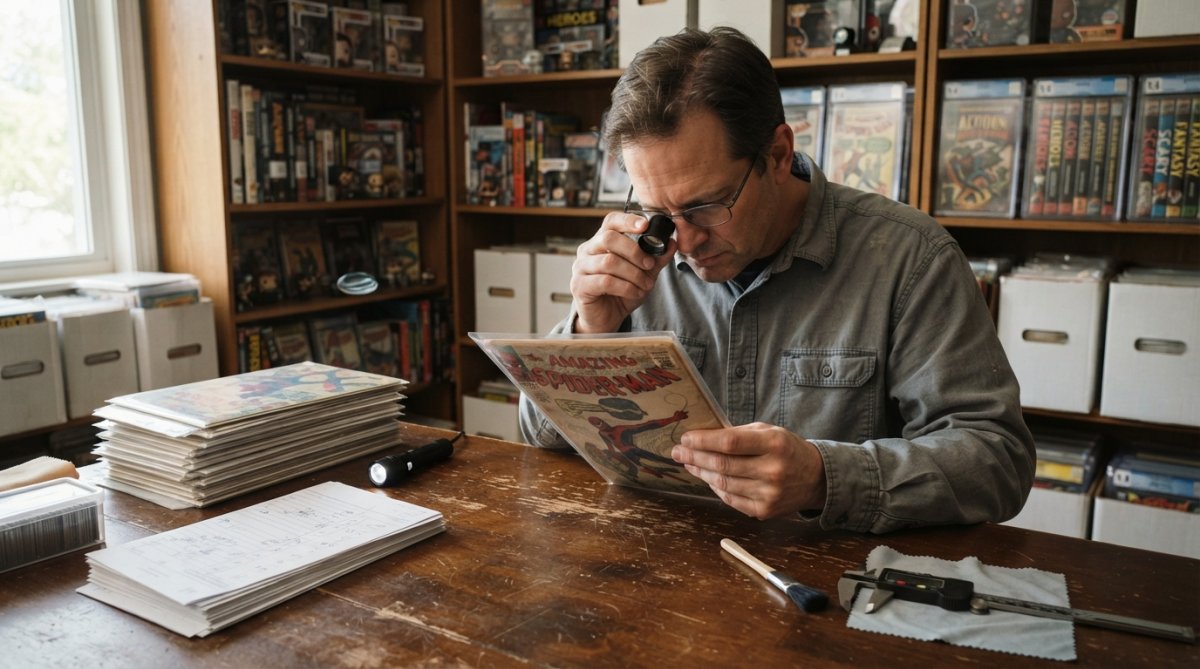
Comic book grading is the standardized process of evaluating a comic's physical condition on a 10-point scale, and it determines the difference between a $5 reader copy and a five-figure investment. This guide breaks down the grading scale, the defects that matter, and when professional grading is worth the cost.
The 10-Point Grading Scale Explained
Grading assigns a numeric condition score from 0.5 to 10.0, with 10.0 being a perfect, unread copy. The industry-standard scale evaluates cover gloss, page quality, spine condition, and structural integrity. A 9.8 (Near Mint/Mint) commands a massive premium over the same issue at 9.0, so understanding where your book falls is the foundation of any smart buying or selling decision (comics.ha.com).
From Gem Mint to Good: What Each Grade Means
The scale breaks into descriptive bands with specific market implications. A 9.9 or 10.0 Gem Mint is essentially flawless, often a modern book pulled from a sealed case. Near Mint (9.0-9.8) shows minimal wear, with 9.8 reserved for books with just a tiny printing defect. Very Fine (8.0-8.5) allows slight spine stress or corner wear, while Fine (6.0-7.0) tolerates more visible creasing. Good (2.0-3.5) books are complete but heavily read, and Poor (0.5-1.8) copies are missing pieces or structurally damaged. The gap between a 9.6 and a 9.8 can double a key issue's value.
How to Spot Comic Book Defects That Lower Value
The most common mistake new graders make is focusing only on the cover. A comic's value is determined by the whole book, and interior defects can drop a grade just as fast as a torn front page.
Spine Stress, Color Breaks, and Creasing
Spine stress appears as fine lines or cracks along the spine fold, often caused by reading or improper storage. Color breaks are the most visible killers: any chip where the cover's color layer is missing, usually at the spine or edges, immediately caps your grade. A book with a single 1-inch color-breaking crease on the spine will rarely exceed a 9.0, and multiple defects compound quickly. Trained graders also check for bindery and printing defects, production flaws that may limit a book to 9.8 rather than 9.9.
The Subtle Defects That Separate 9.4 from 9.8
Most collectors can spot a torn cover or missing page. The real skill is identifying the minor defects that keep a book out of the top tier:
- Spine stress without color break: A faint line along the spine that does not break the color layer can still cap a book at 9.4. Hold the book at an angle under a bright light to see these subtle stresses.
- Corner blunting: A corner that is not perfectly sharp, even without a visible crease, drops a book from 9.8 to 9.6. Run your finger gently over each corner to feel for any softness.
- Surface wear: Microscratches on the cover, often from sliding in and out of a bag, are visible only under raking light. These are common on modern books and cap them at 9.6 or lower.
- Bindery tears: Tiny tears along the top or bottom edge of the spine, caused during the binding process, are production defects. A book with a bindery tear can never grade above 9.4, regardless of how pristine it looks.
- Marvel chipping: On older Marvel comics, the black ink along the spine edge is prone to chipping. Even a few tiny chips can drop a book from 9.0 to 8.0.
Interior Page Condition and Color Quality
Page quality is a grading criterion many casual sellers ignore. The industry uses a standard vocabulary: white pages are the most desirable, followed by off-white, cream, tan, and brown. A book with tan pages will grade lower than an identical copy with white pages, even if the cover is pristine. Open the book and check the centerfold for tears or separation, a common flaw in older books that significantly affects the grade.
Restoration Detection: The Hidden Value Killer
Restoration is any work done to improve a comic's appearance, and it is the fastest way to destroy a book's value if undisclosed. Professional graders use UV light and magnification to detect color touch-ups, re-created spines, and cleaned or pressed pages. Amateur restoration attempts result in a "Restored" label that caps the value at a fraction of an unrestored copy. Here is what to look for when buying raw comics:
- Color touch-ups: Look for areas where the color looks slightly different, too bright, or has a different sheen than the surrounding cover. Use a magnifying glass to check for brush strokes or a slightly raised surface.
- Trimming: If the edges of the book look unnaturally straight or the cover seems slightly smaller than the interior pages, the book may have been trimmed to remove edge wear. Compare the cover dimensions to other copies of the same issue if possible.
- Pressing vs. cleaning: Pressing is generally accepted and does not lower a grade, but cleaning that removes color or paper is restoration. A cover that looks unnaturally bright and glossy for its age, especially on a vintage book, should raise suspicion.
- Spine reconstruction: A re-created spine is a major restoration that is difficult to spot without UV light. Look for a spine that feels different from the rest of the cover, has a slightly different texture, or shows signs of glue residue.
The Cumulative Impact of Minor Defects
Professional grading is about understanding how defects stack. A book with a single tiny spine stress might still hit 9.4. Add a barely visible corner crease, and the grade drops to 9.0. Add a slight color break on the spine, and you are looking at 8.5.
Step-by-Step: How to Grade Comic Books at Home
Grading at home requires a methodical approach and the right tools. With practice, you can get within a half-grade or full grade of the official result.
Tools You Need for Accurate Grading
Gather a few essential items. A bright desk lamp with a daylight bulb reveals surface defects that standard room lighting hides. A magnifying glass or loupe helps inspect spine stress and color breaks closely. A clean, flat surface and cotton gloves prevent you from adding oils or dirt while you handle the book.
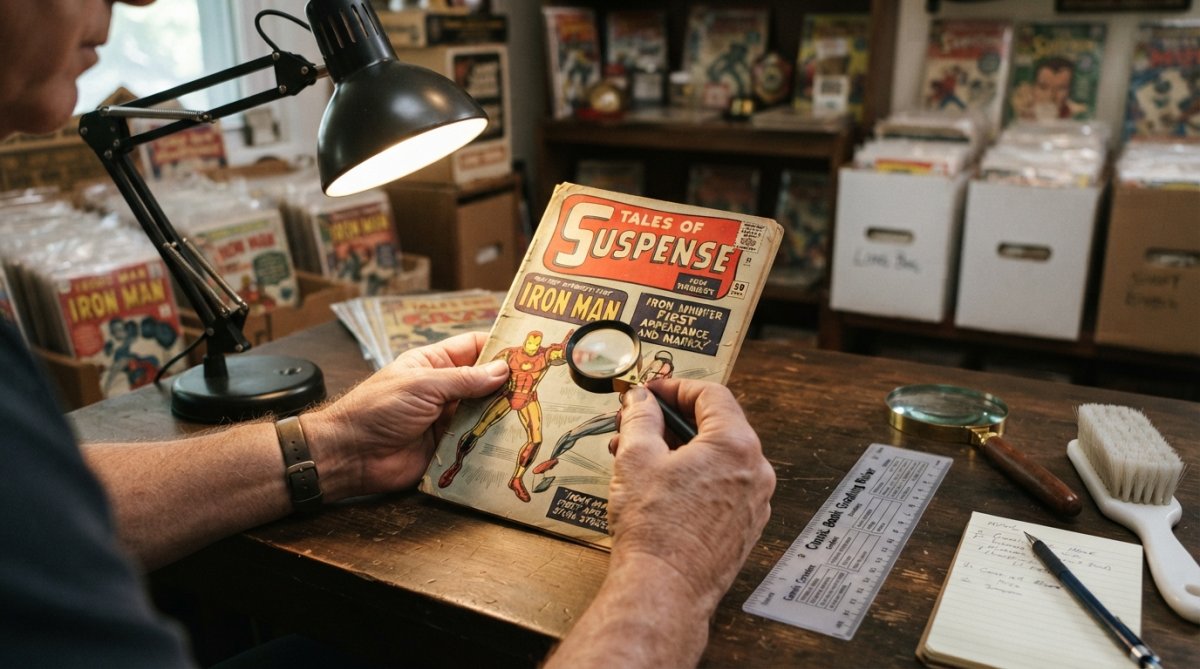
Follow this process for every book:
- Examine the cover under bright light, front and back, noting any color breaks, creases, or stains.
- Check the spine for stress lines, tears, or chipping along the edges.
- Inspect all four corners for wear, blunting, or folds.
- Run your eyes along the edges for tears, especially at the top and bottom of the spine.
- Open the book and assess page color (white, off-white, cream, tan) and check for foxing or tears.
- Confirm the book is complete, with no missing pages or cut-out panels.
- Compare your findings against the 10-point scale and assign a preliminary grade.
DIY Grading vs. Professional Submission
Once you have a preliminary grade, you face the central decision: trust your own assessment or submit to a third-party grading service. DIY grading works well for personal collection organization and for selling raw comics at fair market value. Professional submission provides authentication, encapsulation in a protective slab, and a universally recognized grade that buyers trust.
The 180 Rule and Other Grading Standards
Professional graders apply standards beyond simple defect spotting. The "180 rule" refers to how a book is handled: graders never open a book more than 180 degrees flat, which can stress the spine and create new defects. This discipline is why a raw book you have read multiple times will almost certainly grade lower than you expect.
Understanding CGC Grading Cost and Turnaround
Professional grading is a financial decision, not just a quality assessment. The cost to grade through CGC (Certified Guaranty Company) is not a flat fee; it scales with the declared value of your book and the speed you need.
The Real Cost Structure: Fees, Shipping, and Membership
CGC's pricing is tiered by the maximum declared value of the book. As of this writing, the standard tier for books valued up to $400 runs roughly $25 to $30 per book. The express tier, for books up to $1,500, jumps to around $60 to $75 per book. Walk-through service, for books valued over $3,000, can cost $150 or more per book. These fees are just the starting point. You must also factor in:
- Shipping to CGC: Insured shipping to their facility in Sarasota, Florida, typically costs $15 to $30 depending on the number of books and declared value.
- Return Shipping: CGC charges a non-negotiable handling fee plus the cost of insured return shipping, which can be $30 to $50 for a single slab.
- Membership: You must be a CGC member to submit directly. The lowest tier membership costs around $30 to $40 per year.
- Pressing: If your book needs pressing to maximize its grade, that adds another $15 to $25 per book, plus a longer turnaround.
A single book submitted through the standard tier can easily cost you $80 to $100 all-in. This is the baseline against which you must measure your book's potential value jump.
The Decision Logic: When to Submit and When to Hold
Here is the practical framework that most experienced collectors use before spending a dime on grading fees:
- Estimate your raw grade honestly. Use the process outlined earlier in this guide. Be conservative; assume your book is one full grade lower than your most optimistic assessment.
- Look up the fair market value for that grade. Check recent sales on eBay or Heritage Auctions for the exact same issue in the grade you estimated.
- Look up the value for the next grade up. If your book is a 9.0, what is a 9.4 selling for? What about a 9.6?
- Calculate the potential premium. Subtract the raw value from the higher-grade value. This is your potential upside.
- Compare the upside to your all-in cost. If the potential premium is less than $100, the math does not work. Keep the book raw and sell it as a accurately-described raw book.
- Consider the downside risk. If your book comes back a full grade lower than your estimate, you have lost the grading fee and shipping costs on a book that is now worth less than your raw estimate. This risk is real, especially for modern books with hidden printing defects.
Turnaround Times: The Hidden Variable
Turnaround times are a cash-flow consideration. Standard tier submissions can take four to six months or longer, especially during peak seasons after major conventions. Express tiers return in two to four weeks but cost significantly more per book.
A Smarter First Step: Pre-Grade Before You Pay
Before you spend $100 on a single submission, practice on your own collection. Take ten books you believe are 9.4 or higher. Grade them using the process in this guide, then compare your assessments against actual sales data for those issues. You will likely find you are over-grading by 0.5 to 1.0 points.
For books that clearly fall below the 9.0 threshold, the math rarely works. A 7.0 copy of a key issue might be worth $200, while a 9.0 is worth $800. The $600 premium might justify the fee, but only if you are confident in your 7.0 estimate. The safest submissions are high-grade modern keys where the 9.8 premium is enormous and the condition is relatively easy to assess.
Grading Modern vs. Vintage Comics: Key Differences
Grading modern comics (roughly post-1980) and vintage comics (pre-1970) requires different expectations. Modern books are printed on higher-quality paper with glossy covers, so they can achieve 9.8 or 9.9 grades if stored properly. Vintage comics are judged more leniently on paper quality because off-white and cream pages are the norm for 50-year-old books. A 1940s book with cream pages and minor spine stress can still grade Very Fine, whereas the same condition on a 2020 book would drop it to Fine.
Spotting Restoration: The Hidden Value Killer
Is Professional Grading Worth the Cost?
Professional grading is worth the cost for key issues, high-value vintage books, and any comic you plan to sell or trade. The slab provides authentication, critical in a market flooded with reprints and restored books. For lower-value books you simply enjoy reading or displaying, the cost of grading often exceeds the book's market value. A good rule of thumb is to grade any book you estimate at $100 or more in raw condition, and keep everything else in archival bags and boards.
The gap between a raw comic and a professionally graded slab is not just plastic and a label; it is certainty about condition, authenticity, and market value. Whether you are chasing a 9.8 key issue for your investment portfolio or just want to know what your childhood collection is worth, the skills you build learning to grade will pay for themselves on your very next purchase. At Scottydew Comics, our live auctions feature carefully described raw books and verified graded slabs. Join our community to find your next treasure and get honest guidance on what is actually worth buying.
Frequently Asked Questions
How much does it cost to have a comic book graded?
CGC grading cost varies based on the declared value of your comic and the service tier you select. Standard tiers for modern books are more affordable, while valuable vintage keys require higher tiers. You also pay for shipping and insurance to and from the grading facility. Check the grading company's website for current fee schedules, as prices change. For a casual collector, grading a single $20 comic often costs more than the book is worth, so reserve professional grading for books valued over $100.
Can I grade my own comic books at home?
Yes, you can learn how to grade comic books at home using the official 10-point scale. You'll need a light source, a magnifying glass, and a ruler to check spine stress, color breaks, and corner wear. Home grading is useful for organizing your collection and deciding what to submit professionally. However, only certified third-party graders can issue an official grade and encapsulate your comic in a sealed slab. Think of DIY grading as a skill for valuation, not a replacement for authentication.
What is the difference between raw and slabbed comic books?
Raw comics are ungraded books sold in bags and boards, while slabbed comics have been professionally graded and sealed in rigid plastic holders by services like CGC or CBCS. Slabbing provides authentication, a verified condition grade, and protection from further wear. Raw comics are cheaper to buy and easier to read, but their condition is open to interpretation. The slab's label shows the grade, which removes guesswork and can increase market value for high-grade keys.
What are the primary factors that lower a comic book grade?
The most common defects that lower a grade include spine stress lines, color breaks, corner wear, creasing, and foxing. Interior page quality also matters: white pages grade higher than off-white or tanning pages. Bindery and printing defects can also reduce the grade, even on brand-new books. The harshest penalty comes from restoration, such as color touch or tear repairs, which can drop a book to a Qualified or Restored label. Learn to spot these issues before buying raw comics.
This article was written using GrandRanker
Frequently Asked Questions
How much does it cost to have a comic book graded?
CGC grading cost varies based on the declared value of your comic and the service tier you select. Standard tiers for modern books are more affordable, while valuable vintage keys require higher tiers. You also pay for shipping and insurance to and from the grading facility. Check the grading company's website for current fee schedules, as prices change. For a casual collector, grading a single $20 comic often costs more than the book is worth, so reserve professional grading for books valued over $100.
Can I grade my own comic books at home?
Yes, you can learn how to grade comic books at home using the official 10-point scale. You'll need a light source, a magnifying glass, and a ruler to check spine stress, color breaks, and corner wear. Home grading is useful for organizing your collection and deciding what to submit professionally. However, only certified third-party graders can issue an official grade and encapsulate your comic in a sealed slab. Think of DIY grading as a skill for valuation, not a replacement for authentication.
What is the difference between raw and slabbed comic books?
Raw comics are ungraded books sold in bags and boards, while slabbed comics have been professionally graded and sealed in rigid plastic holders by services like CGC or CBCS. Slabbing provides authentication, a verified condition grade, and protection from further wear. Raw comics are cheaper to buy and easier to read, but their condition is open to interpretation. The slab's label shows the grade, which removes guesswork and can increase market value for high-grade keys.
What are the primary factors that lower a comic book grade?
The most common defects that lower a grade include spine stress lines, color breaks, corner wear, creasing, and foxing. Interior page quality also matters: white pages grade higher than off-white or tanning pages. Bindery and printing defects can also reduce the grade, even on brand-new books. The harshest penalty comes from restoration, such as color touch or tear repairs, which can drop a book to a Qualified or Restored label. Learn to spot these issues before buying raw comics.