 ultimate-guide
How to Identify Comic Variants: A Collector's Guide
Table of Contents
- What Are Comic Variants and Why They Matter
- Understanding Comic Book Cover Ratios and Print Runs
- What Is FOC in Comics and How It Affects Variants
- Step-by-Step Visual Identification Guide
- How to Grade Comic Books for Variant Authentication
- Using Collector Databases and Verification Tools
- Common Mistakes to Avoid When Identifying Variants
- Frequently Asked Questions
Last Updated: September 24, 2026
What Are Comic Variants and Why They Matter
Comic variants are alternate cover versions of the same issue, released simultaneously or during the same publishing window. Rather than a single cover per issue, publishers now print multiple designs, each with its own print run and collector appeal. Understanding how to identify comic variants is essential for anyone serious about building a valuable collection, whether you're hunting for investment-grade books or simply chasing the covers you love.
The variant landscape has exploded over the past decade. A single issue might have five, ten, or even twenty different covers available at launch. This abundance creates both opportunity and confusion. Knowing which variants exist, how to spot them, and what makes them valuable separates seasoned collectors from those who overpay for common printings or miss rare finds entirely.
At Scottydew Comics, we've watched collectors struggle with variant identification for years. The confusion isn't accidental, publishers use similar designs, subtle printing techniques, and complex numbering systems that make spotting variants genuinely difficult without a framework. That's why we've built this guide: to give you the tools to identify comic variants with confidence, whether you're browsing our live auctions on Whatnot or hunting through back issue bins.
Understanding Comic Book Cover Ratios and Print Runs
Cover ratios represent the relative scarcity of variant covers within a single issue's print run. When a publisher releases an issue with multiple variants, they typically print them in specific proportions, a 1:25 ratio variant, for example, means one copy exists for every 25 standard covers ordered. The lower the ratio, the rarer the variant.
This ratio system emerged from the direct market structure, where comic shops place orders with distributors based on expected customer demand. A retailer might order 100 copies of a standard cover but only request one copy of a 1:100 ratio variant. This creates genuine scarcity at the source, not artificial scarcity manufactured after the fact.
How Ratio Variants Work
Ratio variants are ordered exclusively through the direct market, the network of specialty comic shops and distributors that supply collectors. You won't find a 1:50 ratio variant on a newsstand or in a grocery store. These variants exist because retailers specifically request them, knowing their regular customers hunt for rare covers.
The math is straightforward but powerful. If a comic ships with a standard cover and three ratio variants (1:25, 1:50, 1:100), and the standard cover has an open order of 10,000 copies, then approximately 400 copies of the 1:25 exist, 200 of the 1:50, and 100 of the 1:100. These numbers become the foundation of collectibility, fewer copies printed means harder to find, which typically correlates with higher secondary market values.
Identifying Print Run Differences
Print runs vary dramatically depending on title popularity and market conditions. A flagship title from a major publisher might print 50,000 copies of the standard cover in its first month. An indie title from a smaller publisher might print 2,000 total across all variants combined. These differences matter because they determine how many copies actually exist in the collector market.
The best way to identify print run size is through Final Order Cutoff data and publisher announcements. Publishers often release information about how many copies shipped, though they rarely specify variant breakdowns. Collector databases and community tracking have become increasingly sophisticated at estimating print runs based on sales data, auction results, and retailer reports.
What Is FOC in Comics and How It Affects Variants
FOC stands for Final Order Cutoff, the deadline by which retailers must finalize their orders with distributors for a specific comic book issue. Understanding FOC timing is crucial because it directly impacts which variants exist and how many copies were printed.
FOC typically occurs 45-60 days before a comic's official on-sale date. During this window, retailers see advance solicitations with cover images and decide how many copies to order. For variants, this is when the real scarcity gets locked in. A retailer might order 100 copies of the standard cover but only request the 1:50 variant if they have a customer specifically asking for it. Once FOC passes, the order is final, no more copies of that variant will be printed.
This system creates natural rarity tiers. Variants ordered heavily by retailers before FOC exist in larger quantities. Variants that few retailers ordered become genuinely scarce. A variant that seemed common when it shipped might prove surprisingly rare years later when collectors realize how few copies actually exist.
Step-by-Step Visual Identification Guide
Identifying comic variants requires examining multiple physical characteristics simultaneously. No single feature definitively proves a variant, instead, you're building a case based on accumulated evidence.
Start by comparing the cover art directly. Look at the composition, color palette, and artistic style. Standard covers typically feature the main character prominently. Incentive variants often use alternative artwork, different poses, or entirely different scenes. Hold two copies side by side under good lighting and the differences usually become obvious. If you can't see a clear visual difference, you're likely looking at the same cover printed twice.
Next, examine the barcode and cover price area at the bottom of the back cover. This is where publishers encode critical variant information. The UPC barcode itself often differs between variants. The cover price might be identical, but the barcode structure tells the real story. Some variants use standard barcodes while others use variant-specific codes that retailers use to differentiate orders.
Spotting Foil and Special Finish Variants
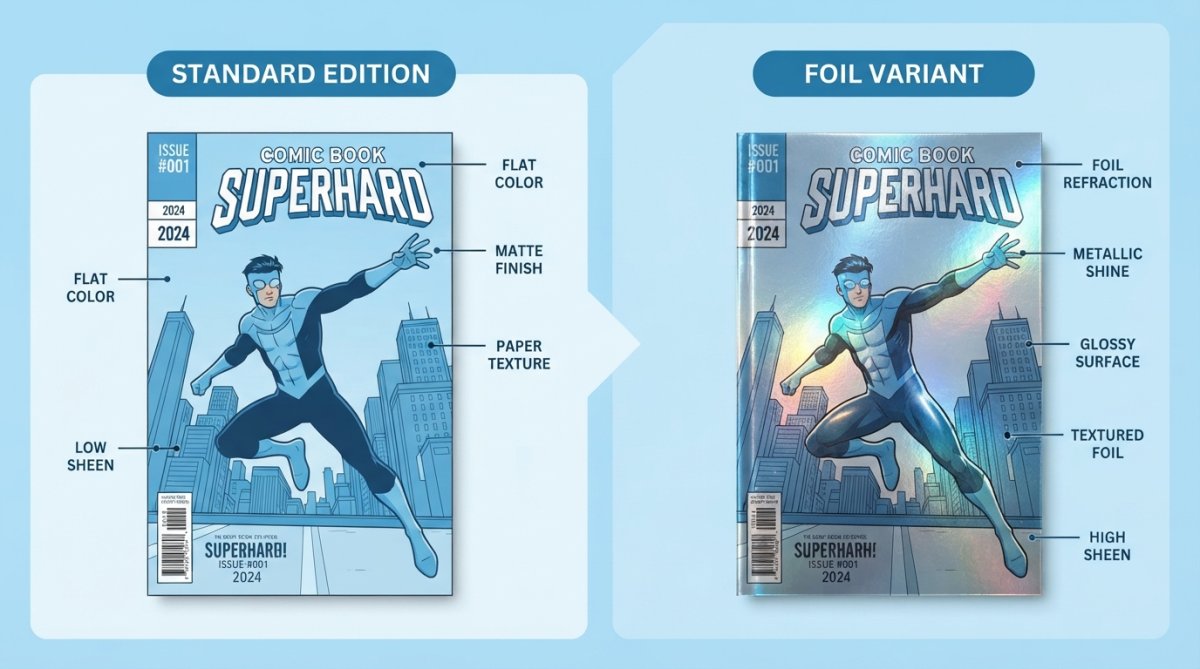
Foil variants feature metallic or reflective coating applied to portions of the cover art. These are easy to spot once you know what to look for. Tilt the book under light and watch how the foil catches the shine. Standard covers remain flat and matte under the same lighting. Foil variants sparkle and reflect light dramatically.
The foil might cover the entire cover, just the title, or specific elements like a character's armor or jewelry. Some foil variants use spot color foil, metallic ink applied only to selected areas. Others use full-coverage foil that makes the entire cover reflective. The application quality varies significantly. Premium variants from major publishers often feature smooth, even foil coverage. Lower-budget variants sometimes show inconsistent foil application with visible gaps or uneven shine.
Other special finishes include embossed covers (raised texture you can feel with your finger), die-cut covers (unusual shapes or cut-outs), and holographic covers (shifting colors and patterns). These variants are obvious once you handle them. The texture and dimension are immediately apparent compared to standard flat covers.
Recognizing Incentive and Retailer Exclusive Covers
Incentive covers are variants designed to reward retailers for ordering larger quantities of an issue. A publisher might offer a free incentive variant for every 25 copies of the standard cover a retailer orders. This creates a direct link between retailer order volume and variant scarcity.
Incentive variants are labeled on the cover itself or in publisher solicitations. Look for text like "1:25 Incentive Variant" printed somewhere on the cover, usually small text near the barcode area or occasionally as part of the cover design itself. Some variants include the incentive ratio directly on the cover art.
Retailer exclusive covers are variants available only through specific comic shops or chains. A major chain might commission an exclusive variant for their stores only. These exclusives are often identified by retailer logos or names printed on the cover. Some retailers print their store name or logo directly on the cover. Others simply control distribution so the variant only appears in their locations.
The challenge with exclusives is verification. Unlike ratio variants with standardized labeling, exclusive variants rely on provenance and retailer records. If you purchased a variant directly from the exclusive retailer, you have confidence in its authenticity.
Reading Barcode Identification and Cover Price
The barcode area contains encoded information about the variant. Comic book barcodes follow a standardized format, but variants use different codes to distinguish themselves in the direct market ordering system.
How to Grade Comic Books for Variant Authentication
Grading serves two purposes: it verifies authenticity and establishes condition. A slabbed comic, one that's been professionally graded and encased in a protective holder, carries third-party authentication that makes variants indisputable.
Using Collector Databases and Verification Tools
Collector databases have become essential infrastructure for variant identification. Platforms like Comic Book Realm, League of Comic Geeks, and MyComicShop maintain comprehensive variant catalogs with cover images, print runs, and pricing history.
Common Mistakes to Avoid When Identifying Variants
The most common mistake is confusing printing variations with variants. A comic might have slight color shifts, barcode placement differences, or minor printing imperfections across copies from the same print run. These are manufacturing variations, not variants. A variant is an intentional, designed-from-the-start alternate cover, not a printing accident.
Frequently Asked Questions
What does a 1:25 variant cover mean?
A 1:25 ratio variant means one variant copy is printed for every 25 standard copies ordered by retailers. This ratio determines scarcity and collectibility. Lower ratios (like 1:10) are more common, while higher ratios (1:50 or above) are rarer and typically command higher prices on the secondary market. The ratio directly reflects how difficult the variant is to find.
How can you tell what edition a comic book is?
Check the barcode area on the back cover for print run information, usually listed as "1st printing," "2nd printing," or similar notation. Examine the cover price and indicia (publisher information on the inside front cover). Compare the cover art, coloring, and paper quality to reference images in collector databases. First editions typically have specific cover artists and layout details that differ from reprints.
What is the difference between an open order and an incentive variant?
Open order variants are available to any retailer who wants to order them, with no minimum purchase requirement. Incentive variants, by contrast, require retailers to purchase a minimum quantity of the standard edition to unlock the variant cover. This makes incentive variants inherently scarcer since fewer retailers can reach the threshold, making them more valuable to collectors.
Are variant comics worth anything?
Yes, variant comics can be worth significantly more than standard editions. Value depends on rarity (determined by print run and ratio), demand from collectors, condition, and market trends. Limited edition variants, especially those with low ratio numbers or from popular cover artists, often appreciate over time. Graded variants in high condition command premium prices on the secondary market.