 Listicle
Comic Book Collecting Mistakes Beginners Make and How to Avoid Them
Last Updated: November 21, 2026
Quick Summary
Most beginners in comic book collecting lose money by chasing hype, skipping price research, misreading condition, grading books without running the numbers, and storing books poorly. Avoiding these habits protects your budget and keeps your books' value intact.
- Buy key issues for their lasting significance, not for hype that fades quickly.
- Check recent sold listings and compare at least three sales before every purchase.
- Assess spine, corners, cover, and pages carefully, since small flaws change value.
- Add up the full grading cost, including shipping and insurance, before submitting a book.
- Store books in acid-free materials in a cool, dry, dark room, away from humidity.
Table of Contents
- Why Most New Collectors Lose Money on Their First Purchases
- Buying Hype Instead of Key Issues and Their Significance
- Skipping Research Before You Buy: A Pre-Purchase Checklist
- Misreading Condition and Grade: A Comic Book Condition Checklist
- Comic Book Grading Basics and When Professional Grading Pays Off
- Storing and Handling Comics So Your Collection Doesn't Lose Value
- Pick Your Next Step: Set a Budget, Define Your Goals, and Start Smart
- Frequently Asked Questions
Why Most New Collectors Lose Money on Their First Purchases
Comic book collecting looks simple from the outside. You find a book you like, you pay for it, and it goes on a shelf.
The good news is that these mistakes are predictable. Once you know what to watch for, you can protect your budget while still enjoying the hobby. This guide walks through the most common errors beginners make and gives you a practical way to avoid each one.
Buying Hype Instead of Key Issues and Their Significance
A new release with a flashy cover often gets bought on excitement alone.
Key issues are different. These are books that matter because of a first appearance, a major story event, or a significant creative milestone.
Before buying, ask yourself why the issue matters. Our comic key issues buying guide covers grading, authentication, and sourcing.
Watch out: buying the first printing of a hyped series can mean paying peak prices right before the market cools.
Skipping Research Before You Buy: A Pre-Purchase Checklist
Many beginners buy the first copy they see without checking recent sales. That is how overpaying starts. Before you commit, look up what the book has actually sold for recently, not just what sellers are asking.
Use this checklist before every purchase:
- Confirm the exact issue number and variant
- Check recent sold listings for the same grade
- Verify the book is not a facsimile or reprint
Research also protects you from counterfeit and misdescribed books. A few minutes of checking often prevents an expensive mistake.
Misreading Condition and Grade: A Comic Book Condition Checklist
Condition is one of the biggest drivers of price, and beginners often misjudge it. A book described as "near mint" can look far rougher in person than the photos suggest.
Here is a simple way to assess condition:
- Spine: Look for stress lines and flattening along the staple.
- Corners: Check for blunting, rounding, or small tears.
- Cover: Inspect for color breaks, scuffs, and fading.
Learn the standard grading scale so your descriptions match what buyers expect. The full comic grading guide walks through how to interpret condition correctly. The better you understand a grade, the less likely you are to pay for condition you do not actually get.
Comic Book Grading Basics and When Professional Grading Pays Off
Professional grading means a third-party company evaluates a book's condition, authenticates it, and seals it in a tamper-evident holder called a slab. Graded books trade with more confidence because the grade is third-party and the book is encapsulated, but grading is a business decision, not a rite of passage.
The real cost stack
Most beginners compare the grading fee to the book's value and stop there. The true cost of a submission usually includes:
- Grading fee, varies by service level, declared value, and any add-on services; check the grader's current published schedule.
- Press and clean, optional but often worth it on books with pressable defects; priced separately and adds turnaround time.
- Shipping to the grader, insured, tracked, and packed to survive handling; cost scales with declared value.
Add those line items before you decide. A book that looks like a $40 grading win can turn into a loss once shipping and pressing are counted.
A simple break-even test
Use this framework before submitting any book:
- Estimate the raw grade. Be honest; most beginners overgrade by a full point or more. If you are unsure, assume the lower grade.
- Estimate the graded grade. Grading does not improve a book. Assume the same grade or one step lower unless you are paying for pressing.
- Look up recent sold prices for the raw book and for the same issue in the likely graded grade. Use actual sold comps, not asking prices.
- Subtract the all-in grading cost (fee + press + both shipping legs + insurance) from the graded sold price.
- Compare that net figure to the raw sold price. If the net graded number is not meaningfully higher, keep the book raw.
Grading tends to pay off more on high-value keys than on mid-grade common books, where fees and shipping can eat the spread. Run the math per book, not per collection.
When grading is usually worth it
- High-value keys where the grade difference is worth far more than the all-in cost.
- Books you plan to sell to buyers who will not bid confidently on raw books.
- Authentication-sensitive books, signed books, variants, and books with forgery risk, where the holder itself adds trust.
When to keep it raw
- Low- and mid-value books where fees and shipping consume the premium.
- Books with pressable defects you have not yet pressed; grade first, then decide.
- Books you want to read or display, slabs are sealed, and cracking one out destroys the grade premium.
- Books you are still learning on, submit later, once your grading eye is calibrated.
Watch out: submitting a book you have not pressed, or one you have overgraded, locks in a lower grade and a sunk cost; get a second opinion on grade before you pay for encapsulation.
Signed books: raw vs. verified
A signature you cannot verify is a signature buyers will discount. If a book is signed in front of you at a signing, keep the signing evidence (photos, witness information, event program) and consider a witnessed or verified signature service so the signature is authenticated on the label. If you bought a signed book without provenance, treat it as raw and price it accordingly.
Storing and Handling Comics So Your Collection Doesn't Lose Value
Most of the value a collector loses is lost slowly, in storage, not in a single bad purchase. Paper yellows, staples rust, covers fade, and spines stress from handling and environment. The good news is that preservation is one of the cheapest parts of the hobby, and a single consolidated protocol covers almost every risk.
The four environmental enemies
- Light, ultraviolet light fades inks and yellows paper. Keep books out of direct sun and away from display lighting that runs hot or emits UV. For specific tips on guarding graded slabs from scratches, UV damage, and physical harm, see graded slab protection tips. If you display books, rotate them and use UV-filtering covers or frames.
- Humidity and moisture, high humidity encourages mold, foxing, and waviness; damp storage rusts staples. Aim for a stable, moderate indoor environment and keep books off basement and garage floors. Humid conditions can lead to staple rust and page waviness when books are stored in an unconditioned space.
- Heat, sustained heat warps covers, softens adhesives, and accelerates aging. Do not store books near radiators, heat vents, or in attics.
- Pests and dust, insects and rodents damage paper and bindings. Sealed, rigid storage in a clean, dry room is the practical defense.
Archival materials that actually matter
- Acid-free bags and boards, use bags and backing boards labeled acid-free and archival. Cheap poly bags and acidic boards can off-gas and stain over years.
- Mylar sleeves, for high-value books, archival polyester (often sold as Mylar) sleeves are the long-term standard; they cost more but are inert and stable.
- Rigid boxes, store upright in comic-specific boxes sized for bags and boards, not in oversized bins where books slump and spines stress.
- No tape on the book, never tape a bag shut against the book or tape pages; adhesives migrate and stain.
Handling mechanics
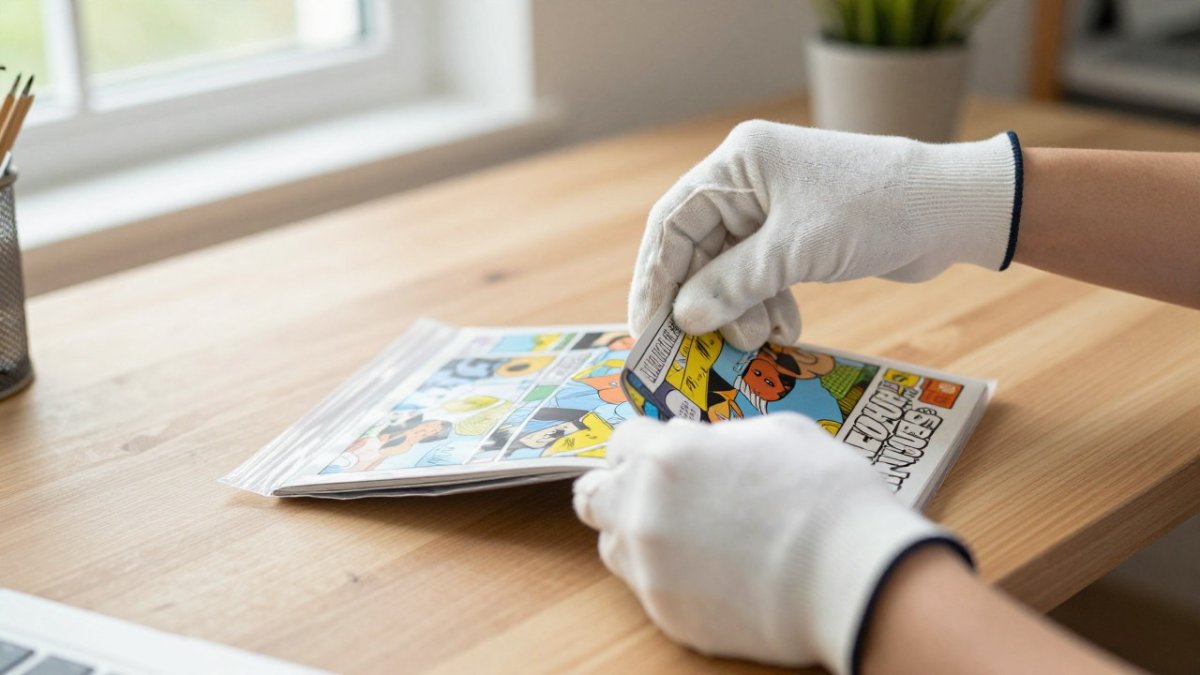
- Handle books by the edges with clean, dry hands; oils and moisture transfer to paper.
- Do not open a book flat or force the spine; open at a shallow angle and support the cover.
- Avoid stacking heavy items on top of books, and do not store books lying flat under weight.
- Keep food and drink away from the work area; a single spill can total a key issue.
Shipping and display
Shipping is where handling mistakes cluster. Pack books with rigid backing on both sides, use a sturdy mailer, and tape the outer seams, not the book. For slabs, check that the case is not cracked, ship in a slab-specific box, and keep slabs away from high heat, which can damage the holder and the label.
Watch out: storing books in a humid basement or garage, or in a hot attic, can cause mold, staple rust, and warping; fix the environment before you buy more supplies.
A simple preservation routine
- Bag and board every raw book in acid-free materials as it enters the collection.
- Store upright in rigid boxes in a cool, dry, dark room.
- Inspect the collection once or twice a year for moisture, pests, and staple rust.
- Rebag high-value books on a schedule and replace any damaged supplies.
- Keep a simple inventory with purchase price, grade estimate, and storage location so you can find and protect your best books first.
Most collectors lose value slowly through poor storage, so these environmental risks and fixes are worth checking early.
| Risk | Effect | Fix |
|---|---|---|
| Light | Fades inks and yellows paper | Keep out of direct sun; use UV-filtering covers |
| Humidity and moisture | Mold, foxing, staple rust, waviness | Stable moderate indoor environment; avoid basements and garages |
| Heat | Warps covers, softens adhesives | Keep away from radiators, vents, and attics |
| Pests and dust | Damages paper and bindings | Sealed rigid storage in a clean, dry room |
| Tape on book | Adhesives migrate and stain | Never tape bags shut against the book |
Pick Your Next Step: Set a Budget, Define Your Goals, and Start Smart
The fastest way to avoid these mistakes is to set a plan before you buy. Decide how much you can spend each month, and whether you are collecting for enjoyment, long-term value, or a mix of both.
Start small. Pick a focused area, learn it well, and expand only when you understand the market. Scottydew Comics offers live auctions on Whatnot, themed shows, and exclusive bundles, so you can explore the hobby at your own pace and join a community of collectors at every level.
Frequently Asked Questions
What should you look for when collecting comic books?
Start with the issue number, first appearances, and key story moments, since these drive long-term demand. Check the cover price, print run indicators, and whether the book is a variant or a reprint. Then judge condition under good light, checking spine stress, corner wear, color breaks, and page quality. Compare what you're considering against recent sold listings rather than asking prices, because sold data shows what buyers actually paid. Buying a few well-chosen books beats accumulating many without a clear plan.
How can beginners avoid overpaying for comic books?
Look up recent sold listings for the exact issue and grade before bidding or buying. Set a maximum price in advance and write it down so you are not swayed by live auction excitement. Be wary of hype-driven spikes after a movie or TV announcement, which often fade. Compare a seller's price against two or three other sources. If a deal depends on urgency or a countdown, slow down and check the market first, because pressure is the most common reason beginners overpay.
Should you buy key issues when starting a comic collection?
Key issues can hold value well, but they are also the most expensive and the most likely to be counterfeit or poorly graded, so they are not always the right first purchase. Many beginners do better starting with affordable books tied to a character or era they genuinely enjoy, then moving into keys once they understand condition and pricing. If you do buy a key, buy from reputable sellers, verify the grade, and keep receipts and documentation for future resale.
How should comic books be stored to prevent damage?
Keep books in acid-free, archival-quality bags with acid-free backing boards, and store them upright in short boxes rather than long ones so spines are not stressed. Keep them in a cool, dry, dark place away from direct sunlight, humidity, and temperature swings, which cause yellowing and warping. Avoid rubber bands, tape, and adhesive labels on the books themselves. Handle comics by their edges with clean, dry hands, and inspect your collection periodically for moisture or pests.