 Comparison
Proxy vs Live Bidding: Which Works Best for Collectors
Last Updated: November 13, 2026
Quick Summary
Proxy bidding means you enter the highest amount you will pay, and the system bids for you in set increments only as high as needed to keep you in the lead. Live bidding means you place bids in real time while the auction runs, responding to other bidders as the price climbs. The main difference is that proxy bidding lets you set a ceiling in advance without being online.
- Proxy bidding raises your bid automatically, only as much as needed to stay in the lead.
- The final price can stay below your maximum when no other bidder competes.
- Live bidding requires you to be present and bid manually during the session.
- Set your maximum with the book's value, buyer's premium, and shipping included.
- Choose proxy bidding if you cannot attend the close; choose live bidding for real-time competition.
Table of Contents
- Proxy Bidding and Live Bidding Defined
- How Does Proxy Bidding Work?
- How to Set a Maximum Proxy Bid
- Difference Between Proxy Bidding and Live Bidding: A Worked Example
- Live Auction Bidding Strategy for Collectors
- Fees, Premiums, and Total Cost on Each Format
- Proxy vs Live Bidding: Pros and Cons
- Which One Should You Choose?
- Choosing Your Bidding Method at Scottydew Comics
- Frequently Asked Questions
Proxy Bidding and Live Bidding Defined
Proxy bidding and live bidding are two ways to place a bid in a comic auction, and they differ mainly in when and how your bid gets entered. At Scottydew Comics, we run live auctions. Knowing how each one works is the first step to choosing the right method for a given book.
What proxy bidding is
Proxy bidding is a method where you enter the highest amount you are willing to pay, and the auction system bids for you in set increments until another bidder beats you or you reach your maximum. You do not have to watch the auction. Once you set your ceiling, the system handles the back-and-forth.
FrontStream's explainer on straight bidding versus proxy bidding
What live bidding is
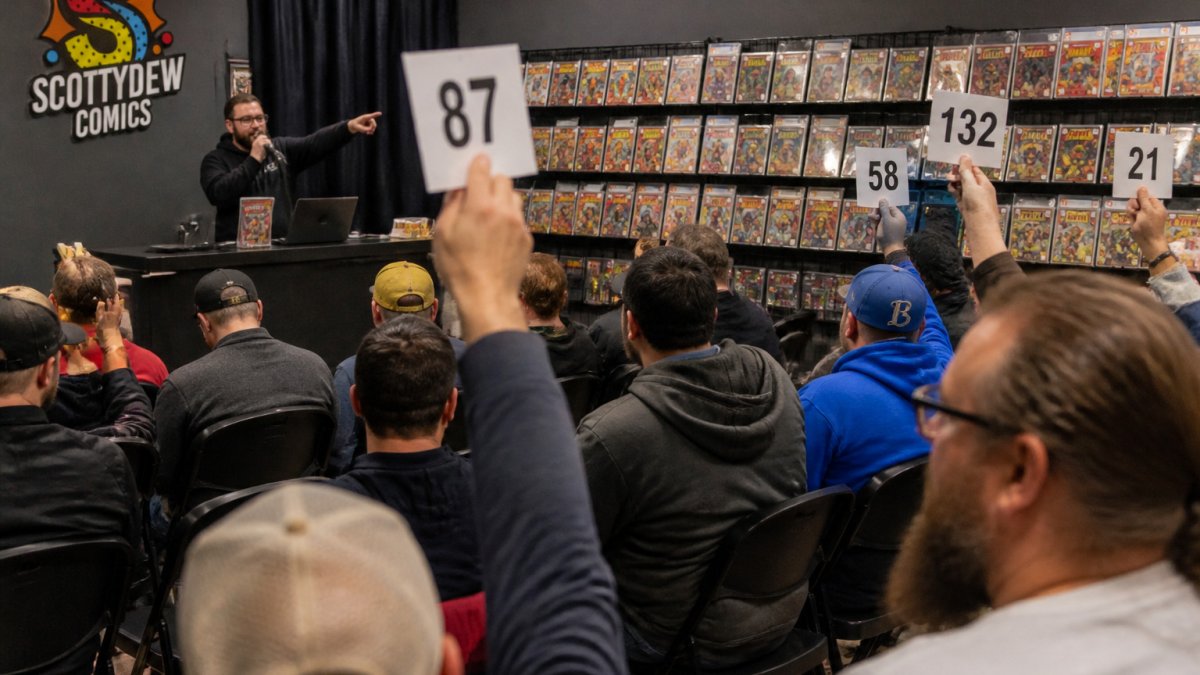
Live bidding means you place bids in real time while the auction is running. You raise your hand, click a button, or call out an amount, and you respond to other bidders as the price climbs. It rewards collectors who want to watch the action unfold and react to competing bids as they happen.
How Does Proxy Bidding Work?
Proxy bidding works by letting the system raise your bid automatically, only as high as needed to keep you in the lead. Suppose the current bid is $100 and the increment is $5. If you set a maximum of $250, your bid will not jump straight to $250. The system bids the minimum needed to win, so you might only pay $105 if no one else competes.
This is why the final price can stay below your maximum. The proxy system bids only as much as it must, which can keep the winning price lower than the ceiling you set.
RallyUp's guide to English-style and proxy auction bidding
How to Set a Maximum Proxy Bid
Setting a maximum proxy bid is about deciding your real limit before you start bidding. Work through these steps:
- Check the book's value. Look up recent sales of the same title, issue, and grade.
- Add the fees. Buyer's premiums and any shipping or handling costs raise your real cost, so factor them in.
- Subtract a margin. Leave room for your own cushion so you are not tempted to chase the item past your limit.
- Enter the number and stop. Once the maximum is set, avoid raising it in the heat of the moment.
Difference Between Proxy Bidding and Live Bidding: A Worked Example
A single worked example makes the mechanical difference clear. Consider one comic with a $100 opening bid and $5 increments, and three bidders.
- Proxy scenario: Bidder A submits a proxy maximum of $200 before the auction opens. Bidder B submits a proxy maximum of $150. The system does not jump either bid to its ceiling. It raises A's bid only as far as needed to beat B, so the book sells at roughly $155, one increment above B's maximum. Neither bidder had to be online at the close, and neither paid their stated ceiling.
- Live scenario: Bidders A and B wait in the session. Each sees the other's bid and responds in real time. The auctioneer calls increments, and the price climbs as each person decides whether to continue. The final number depends on who is willing to keep pushing in the moment, not on a pre-set ceiling.
The mechanical difference is not just timing. It is who applies the increment and who decides when to stop.
How a live bid meets a standing proxy maximum
This is the interaction most explanations skip. Suppose Bidder A has a standing proxy maximum of $200, and Bidder C joins the live session and bids $160. The system does not accept C's $160 as the leading bid if A's proxy can cover it.
A common pattern is that the live bidder only wins when their bid exceeds the proxy maximum. If C bids $205, A's proxy can no longer respond, and C becomes the high bidder at $205. The proxy bidder never pays more than the stated maximum, and the live bidder never wins for less than one increment above that maximum.
Bid priority and tie-breaking
When two proxy bids are equal, platforms generally award priority to the bid received first. If Bidder A submits a $200 maximum on Monday and Bidder B submits a $200 maximum on Wednesday, A typically holds the lead at the same price. Rules vary by auctioneer, so check the platform's terms before relying on submission time.
What the example shows
| Situation | Proxy bidder | Live bidder |
|---|---|---|
| Live bid below proxy maximum | Wins at next increment above the live bid | Must bid again to stay in |
| Live bid above proxy maximum | Loses; pays nothing above maximum | Wins at the live bid amount |
| Two equal proxy maximums | Earlier submission usually wins | Not applicable |
| No competing bids | Wins at opening bid or reserve | Not applicable |
The proxy method sets your ceiling in advance and lets the system handle increments. The live method puts you in the room, so your decisions depend on the energy of the bidding and the bids you see as they happen. Neither method is universally cheaper, the outcome depends on how many bidders compete and how high their ceilings are.
Live Auction Bidding Strategy for Collectors
A live auction rewards preparation. Decide your maximum before the session starts, and write down which books matter most to you so you can focus your budget.

Our [article: Avoid Overpaying at Live Comic Auctions: A Collector's Guide | page:2] covers the specific tactics for staying disciplined, and [article: Early or Late Bidding: Which Wins Rare Comic Auctions | page:1] explains how timing affects your results.
Fees, Premiums, and Total Cost on Each Format
The price you see on the screen is rarely the price you pay. See the full list of costs and risks to weigh before bidding live before you commit to a maximum. Buyer's premiums, shipping, and handling can add cost to a win, and pricing depends on the specific auction and delivery details. Learn how live comic auctions work, including buyer's premiums and proxy bids.
What changes is how easy it is to forget those fees while the price climbs. Review the full list of costs before the auction starts. For current fees and quotes, check the Scottydew Comics website.
Watch out: Collectors who only track the hammer price can underestimate their real cost. Add every fee you expect to pay to your maximum before you bid.
Proxy vs Live Bidding: Pros and Cons
Proxy bidding
- Pros: You can bid without being online, you set a firm ceiling in advance, and the system often keeps the final price below your maximum.
- Cons: You lose the chance to react to competitors, and a poorly chosen maximum can leave you paying more than you intended.
Live bidding
- Pros: You can respond to competing bids in real time, and the experience is engaging for collectors who enjoy the energy of a live session.
- Cons: The pace can push you past your plan, and you must stay present for the whole session.
| Factor | Proxy Bidding | Live Bidding |
|---|---|---|
| Need to be online | No | Yes |
| Reacts to other bids | Automatically, up to your maximum | Manually, in real time |
| Price control | Set maximum in advance | Depends on in-session decisions |
| Best for | Set-and-forget bidding | Interactive, social bidding |
Which One Should You Choose?
The right method depends on your goals and circumstances, not on which format is inherently better. Use these questions to decide.
Can you be present for the whole session?
If you cannot watch the auction close, proxy bidding is the practical choice. A proxy maximum works whether you are at your desk or asleep. Live bidding requires you to be engaged when the lot comes up, and missing the moment means missing the bid.
How firm is your budget?
Proxy bidding enforces discipline mechanically: once your maximum is set, the system cannot exceed it. Live bidding relies on your own restraint while the price climbs and other bidders respond. Collectors who know they are susceptible to auction fever often find the proxy ceiling easier to honor.
How important is the item?
For a book you have researched and valued carefully, a proxy bid lets you set a precise ceiling and walk away. For a book you want to chase and are willing to pay a premium for, live bidding gives you the chance to react to competition and adjust in the moment, provided you have already decided your true limit.
Do you value the social side?
Live bidding is interactive. You see rivals bid, you feel the pace, and you respond. Some collectors find that engaging; others find it distracting. Proxy bidding is quieter and more analytical.
A simple decision rule
| Your situation | Recommended method |
|---|---|
| Cannot attend the close | Proxy |
| Firm budget, high discipline needed | Proxy |
| Want to react to rivals in real time | Live |
| Item is a priority and you can stay engaged | Live, with a written maximum |
| Unsure of value and want to watch first | Watch live, then proxy on a later lot |
Many experienced collectors use both. They place proxy bids on items they have already valued and join live sessions for books they want to chase. The key is to match the method to the circumstance rather than defaulting to one format for every auction.
Watch out: A proxy maximum that is set too high can still result in overpaying if the market is thin, and a live session can push you past a limit you never wrote down. In both formats, the safeguard is the same: decide your total cost, including buyer's premium and shipping, before you bid.
Choosing Your Bidding Method at Scottydew Comics
At Scottydew Comics, our live auctions give you the chance to bid in real time with a community of collectors who enjoy the hobby as much as you do. Compare the top-rated comic auctions online if you are still deciding where to bid. Compare the two approaches above, set your maximum, and join us for a session.
Frequently Asked Questions
What is a proxy bid example?
Say the current bid on a graded key issue is $200 and the next increment is $25. You enter a maximum proxy bid of $500. The system bids $225 for you, and if another bidder raises the price, it keeps raising your bid in $25 steps until it reaches $500 or you win. You never reveal your full maximum, and you pay only enough to beat the next competing bid, not your ceiling.
What is the difference between proxy bidding and live bidding?
Proxy bidding means you submit one maximum amount in advance and the platform bids incrementally on your behalf. Live bidding means you place each bid yourself during the auction session, reacting to the price in real time. Proxy bidding suits collectors who cannot watch the session or want to set a firm ceiling. Live bidding suits those who want to compete directly and adjust as the room or chat reacts.
Can you bid live after placing a proxy bid?
On many platforms, yes, but the rules vary. A live bid placed at a higher amount than your proxy maximum will usually override it, and some systems will let your proxy continue competing afterward. Check the auction rules for the specific item before assuming how the two interact, since mixing methods on the same lot can leave you paying more than you intended.
How does proxy bidding work in an online auction?
After you set a maximum, the system records it privately and bids only the minimum needed to stay ahead of other bidders, up to your ceiling. Because it stops at the lowest winning amount, proxy bidding often results in a lower final price than an open bidding war. Once your maximum is reached, you are outbid unless you raise it. Review the bid history after each session to confirm how your proxy performed.